Tag: Ocean Chemistry and Ecosystems

Scientists at AOML monitor the impacts of ocean acidification on reefs with new series of buoys 

Divers drop over the gunnel. Tanks, weights, divers, and a mesh bag full of tools all descend in emerald waters beneath grey skies. Off the vessel’s bow, a yellow beacon blinks with a red flashing light and a thin data cable stretching to the seafloor, all connected to a suite of sensors twenty feet below […]

Read Full Article

From sample to source: tracking pollution pathways in AOML’s Molecular and Environmental Microbiology Lab

With sterile sample bottles at the ready, scientists in the Molecular and Environmental Microbiology Lab at NOAA’s Atlantic Oceanographic and Meteorological Laboratory (AOML) prepare to capture water samples for analysis in the lab. Invisible to the naked eye, nutrients, pollutants, and entire communities of bacteria, algae, and other microorganisms drift through these waters leaving clues […]

Read Full Article

Scientists at AOML lead workshop for international Surface Ocean CO2 Reference Observing Network (SOCONET) 

Last week, scientists with AOML’s Ocean Carbon Cycle team led a workshop under the international Surface Ocean CO2 Reference Observing Network (SOCONET) on best practices for maintaining an underway pCO2 system and quality-controlling data to standardize crucial measurements of the surface ocean’s uptake of carbon.  The global ocean takes up carbon from the atmosphere on […]

Read Full Article

In the wake of hurricanes: satellites and robots reveal an altered biogeochemical landscape

On August 30, 2023, Hurricane Idalia made landfall as a major Hurricane in Florida’s Big Bend after meandering through the northwestern Caribbean and intensifying over the warm waters of the Gulf of America. In its aftermath, damage on land was immediately visible, but observations from satellites and ocean-going robots revealed that the ocean was also […]

Read Full Article

The robot and the reef: Can enriched seawater fast-track coral restoration?

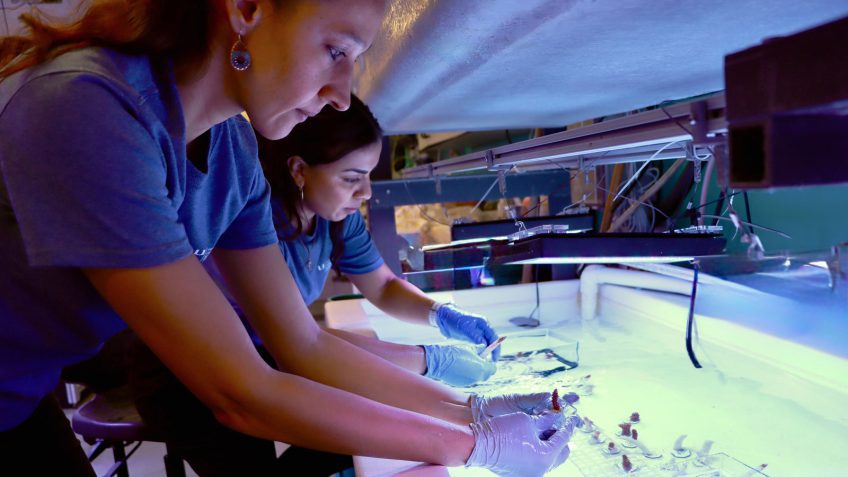
Alkalinity enrichment in the lab may be the key to more effective reef restoration. An innovative Ph.D. student puts this hypothesis to the test using cutting-edge technology. In a tank filled with glass jars, stir bars, and coral babies settled onto ceramic tiles, a robotic arm glides with precision, dosing each jar with various levels […]

Read Full Article

Offspring of opportunity: First-ever spawn collected from urban corals in Miami could bolster future reefs

Scientists at NOAA’s Atlantic Oceanographic & Meteorological Laboratory (AOML) and the Cooperative Institute for Marine and Atmospheric Studies (CIMAS) have successfully overseen the first-ever crossbreeding between grooved brain corals (Diploria labyrinthiformis) collected from a highly urbanized site in PortMiami and a nearby reef – a breakthrough that could revolutionize efforts to restore local coral reefs.

Read Full Article

Scientist at AOML selected as member of NOAA in the Caribbean Executive Team

Jen McWhorter, Ph.D., a Cooperative Institute for Marine and Atmospheric Science (CIMAS) Assistant Scientist with AOML’s Ocean Biogeochemistry and Physical Oceanography teams, has been selected to serve a one year term as a member of the NOAA in the Caribbean Executive Team. As a member of the Executive Team, McWhorter will help provide strategic direction […]

Read Full Article

AOML’s 2025 intern cohort gains first-hand research experience

In celebration of National Intern Day, NOAA’s Atlantic Oceanographic & Meteorological Laboratory (AOML) is proud to recognize its FY 2025 class of interns. Ranging from high school to graduate students, these talented individuals are gaining hands-on experience across a wide array of research areas—including coral reefs, microbial ecology, hurricanes, ocean acidification, physical oceanography, science communication, […]

Read Full Article

A new model predicts dynamic seawater chemistry on Florida’s coral reefs 

Water masses move over reefs, seagrass beds, and sandbanks – and as they do, the seawater chemistry changes.  In the Florida Keys, changes in coral reef carbonate chemistry are driven by benthic metabolism, the origin of the water mass, and the connectivity of habitats. A new study from NOAA’s Atlantic Oceanographic and Meteorological Laboratory (AOML) […]

Read Full Article

Australia to Thailand: I09N GO-SHIP cruise completes voyage 

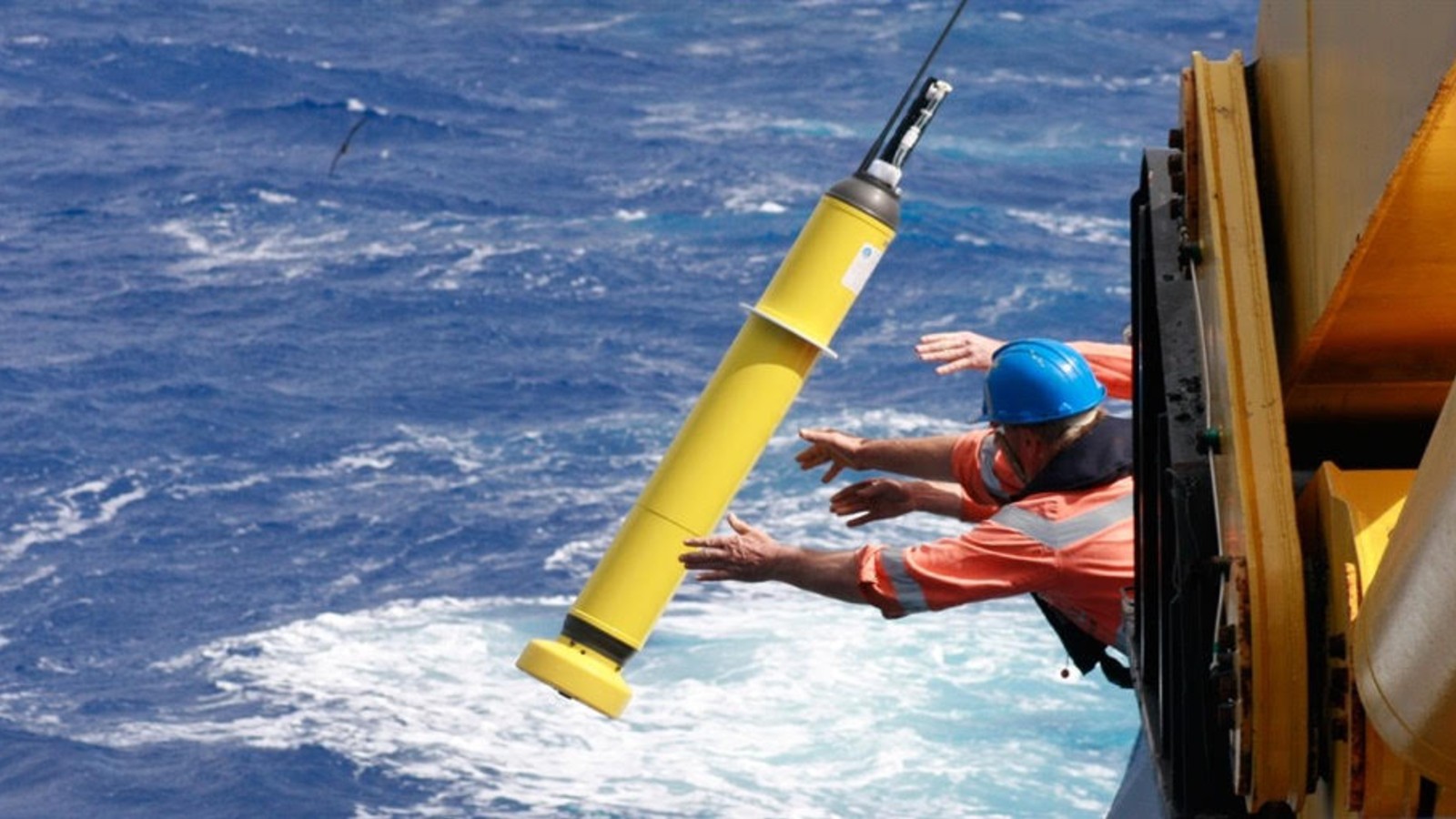
After nearly 40 days at sea, the I09N GO-SHIP cruise (short for “Global Ocean Ship-based Hydrographic Investigations Program”) aboard the R/V Thomas G. Thompson arrived in Phuket, Thailand on April 27th, successfully completing its mission surveying both the Indian Ocean and Bay of Bengal. After departing from Fremantle, Australia on March 21st, the international team of researchers spent weeks collecting data essential for investigating global changes in ocean physics, chemistry, and biology.

Read Full Article