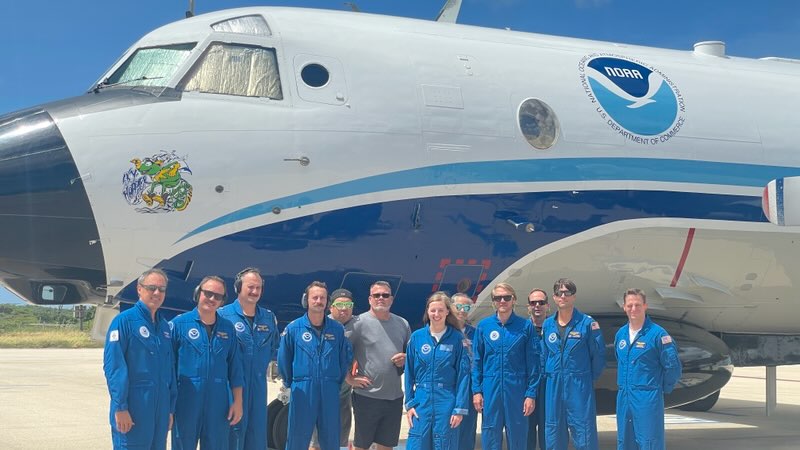
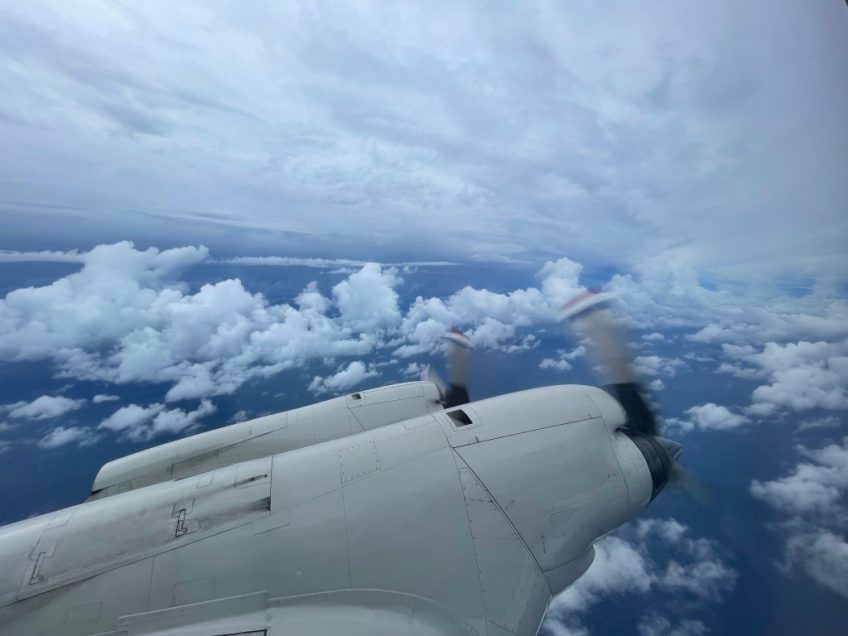
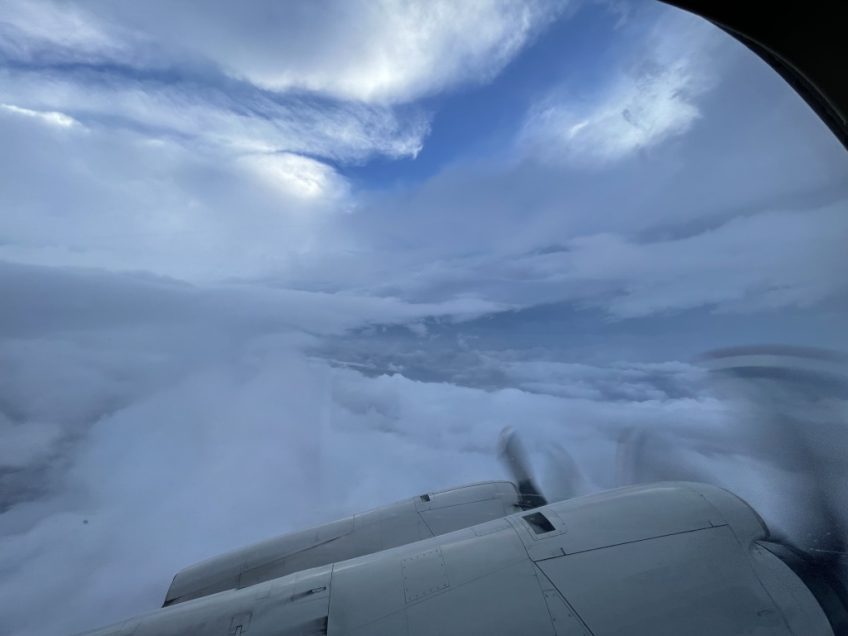
NOAA hurricane researchers have added a new tool to their toolbox. For the first time, an Area-I Altius-600 uncrewed aircraft system was deployed into a hurricane by scientists at NOAA’s Atlantic Oceanographic and Meteorological Laboratory while onboard a NOAA WP-3D Orion Hurricane Hunter aircraft (N42RF, “Kermit”). This uncrewed aircraft system (UAS) is capable of operating in low- and […]
Read Full Article
Despite the late start to the 2022 Atlantic Hurricane season, NOAA Hurricane Hunters have been very busy flying operational and research missions into and around Hurricanes Earl, Fiona, and Ian during the last few weeks. HRD scientisst Rob Rogers and Trey Alvey talk about their upcoming mission. Listen in here and here. For more information, […]
Read Full Article
Scientists from NOAA’s Hurricane Research Division and NOAA’s National Environmental Satellite Data and Information Service have flown a series of missions into Hurricane Ian from the time it was a tropical depression in the eastern Caribbean. On board both NOAA P3s (Kermit & Miss Piggy), they have documented its growth into a hurricane now moving […]
Read Full Article
Summary: The Atmospheric Dynamics Mission – Aeolus was launched into space in August 2018, by the European Space Agency. It is the first satellite capable of observing wind velocity around the world from the surface to 30 km above. This study describes the impact of incorporating these wind observations into computer weather models on tropical cyclone […]
Read Full Article
NOAA continues to fly missions into Hurricane Fiona as it moves northward away from the Caribbean Sea and intensifies into a dangerous Category-4 hurricane. During a P-3 flight on the afternoon of 20 September, the crew captured some great images inside the eye of the hurricane. Photographs inside the eye of Hurricane Fiona showing the […]
Read Full Article
On the night of September 19th, 2022, NOAA Hurricane Hunter “Miss Piggy” penetrated the eyewall of Hurricane Fiona as it emerged from the northern coast of Hispañola. The researchers onboard captured data of an intensifying storm as it moved toward the Turks and Caicos Islands. During the course of the flight, instruments onboard measured a […]
Read Full Article
Investigating Coral Disease Transmission and Mitigation Strategies SCROLL TO LEARN MORE What We Do Coral disease outbreaks have been increasing in number and frequency over the past several decades, and represent a significant threat to coral health and population persistence worldwide. Florida’s coral reefs are currently experiencing a multi-year mortality of corals due to a [...]
Read Full Article
Modeling the interaction between the atmosphere and the ocean is important for accurate forecasting of tropical cyclones, especially their intensities. Because these interactions are so complex, we typically model these interactions using what we call parameterizations to estimate what is really happening. One parameter, the drag coefficient, is the resistance between motions in the atmosphere […]
Read Full Article
As NOAA begins flights into Tropical Storm Fiona, we want to celebrate the first International Cloud Appreciation Day. Sponsored by the Cloud Appreciation Society, this is an internationally recognized day when people around the world are encouraged to spend a few moments appreciating the beauty of the sky. We thought we’d share some of the […]
Read Full Article
Meet Rob Rogers, Lead Meteorologist of AOML’s Hurricane Research Division Observations Team. Rob researches the physical processes underlying tropical cyclone structure and intensity change using airborne observations and numerical models. He is one of many scientists who fly aboard NOAA’s Hurricane Hunter aircraft to support AOML’s research goals. In his free time, Rob enjoys staying […]
Read Full Article