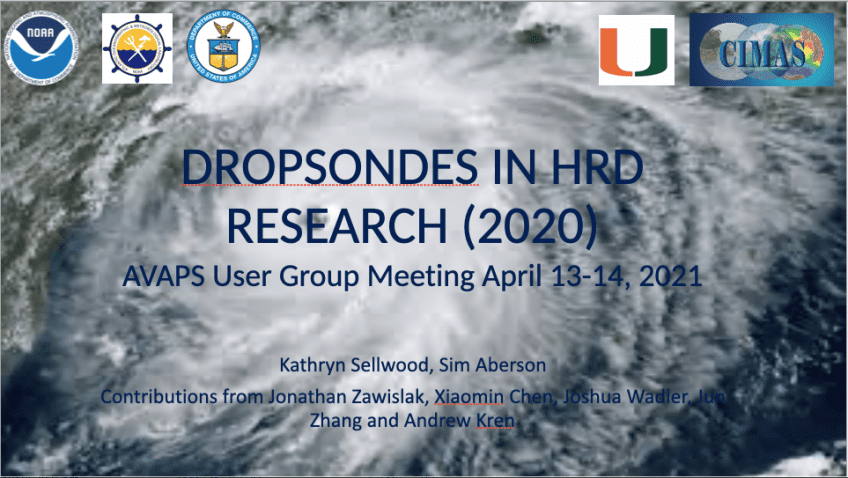
The annual meeting, held online this year, brings together developers and users of the Airborne Vertical Atmospheric Profiling System, the basis of the dropwindsondes released in and around tropical cyclones each summer since 1997. The AVAPS dropsondes are released from NOAA and Air Force aircraft to measure high-resolution profiles of temperature, pressure, humidity, and wind […]
Read Full Article
AOML recently hosted a series of webinars about what AOML does and how it contributes to scientific advancement across the globe. You can catch Jon Zawislak, Rob Rogers, Joe Cione, and Shirley Murillo talking about hurricanes, or listen in on recordings of panels on coasts and coral reefs, and ocean research, and even a panel […]
Read Full Article
Dr. Heather Holbach participated in the SHared Operation REsearch Logistics In the Nearshore Environment (SHORELINE21) Workshop on April 26-27, 2021. This workshop brought together experts from the fields of wind/coastal engineering, atmospheric science, oceanography, ecology, emergency management, and crisis communications to discuss field and laboratory research related to landfalling hurricanes, with a focus on reducing […]
Read Full Article
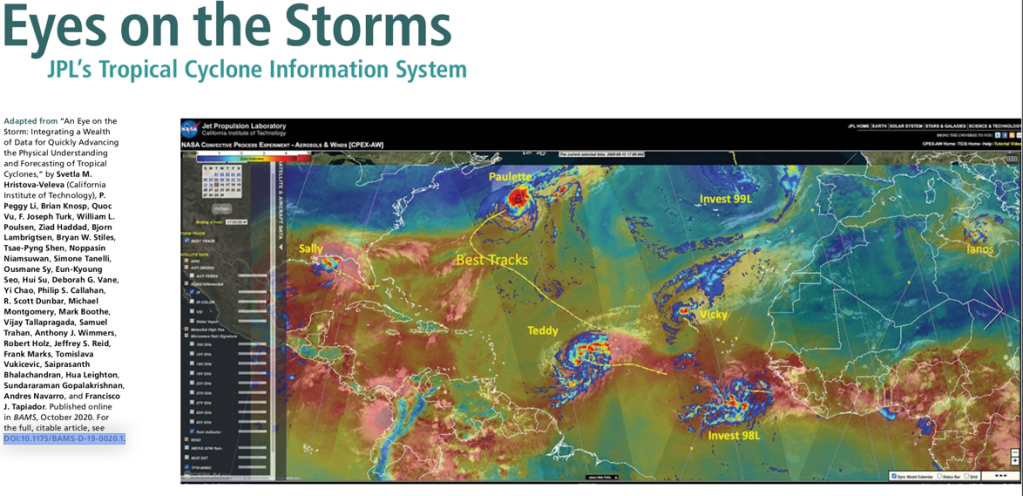
HRD scientists Frank Marks, Hua Leighton, and Sundararaman Gopalakrishnan worked on making this system reality.
Read Full Article
The energy that fuels tropical cyclones comes from heat and moisture from the warm ocean below. This energy is transferred from the ocean to the atmosphere and the momentum is transported from atmosphere to surface by what we call turbulent processes in the atmosphere near the ocean surface (what we call the planetary boundary layer […]
Read Full Article
Summary: To warn people who are in harm’s way from a tropical cyclone (TC), not only is it important to know where it is going and how strong it will be, but also how large it is. We usually measure that by looking at how far away from the center of the TC wind of […]
Read Full Article
Argo Program An Array of Profiling Floats Observing the Ocean in Real-Time JUMP TO DATA JUMP TO OPERATIONS JUMP TO BGC-ARGO OR SCROLL TO LEARN MORE Who We Are What We Do Argo is an international program that collects information from inside the ocean using free drifting profiling floats. These floats drift with the ocean [...]
Read Full Article
The American Meteorological Society (AMS) Committee on Radar Meteorology hosted a webinar on 31 March 2021, where a panel of five scientists from various sectors of the atmospheric sciences reflected on their careers thus far, and how radar has been a foundational part of their journey. Participants learned about a variety of career opportunities while […]
Read Full Article
Summary: The energy that fuels tropical cyclones comes from the heat and moisture in the warm ocean water below. In a classical theory for tropical cyclone intensification, called Wind Induced Surface Heat Exchange or WISHE, an increase in surface wind speed allows for greater energy transfer from the ocean to the atmosphere (Fig. 1a). This […]
Read Full Article