Paper on a new way to perform data assimilation on very large computers published in Monthly Weather Review
You can read the study at https://journals.ametsoc.org/doi/pdf/10.1175/MWR-D-18-0022.1.
You can read the study at https://journals.ametsoc.org/doi/pdf/10.1175/MWR-D-18-0022.1.


Read the paper at http://159.226.119.58/aas/EN/10.1007/s00376-018-8036-3.

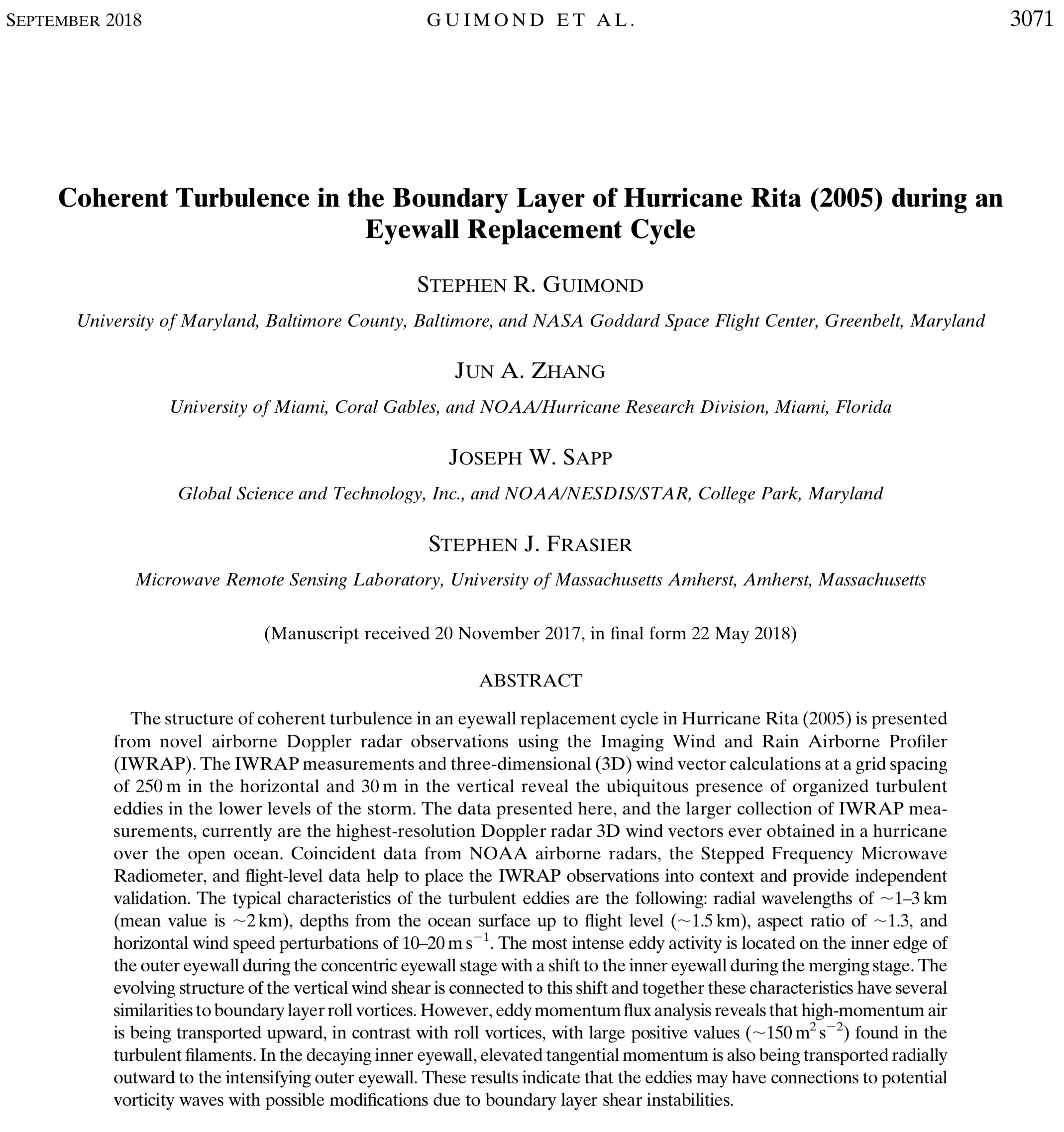
Summary:Knowing what is happening in the boundary layer of a hurricane (the area from the ocean surface up to about 1 km height) is very important for making accurate forecasts of how strong the hurricane will get. But measuring temperature, moisture, and wind so close to the ocean surface is dangerous and difficult. In the […]


Summary: The CYclone Global Navigation Satellite System (CYGNSS) was launched into space on December 15, 2016, to improve hurricane (tropical cyclone) forecasts by measuring wind speed on the ocean surface. Since the tropical cyclones mostly occur over oceans where other wind data are usually not available, the new observations can measure their wind speeds. This […]
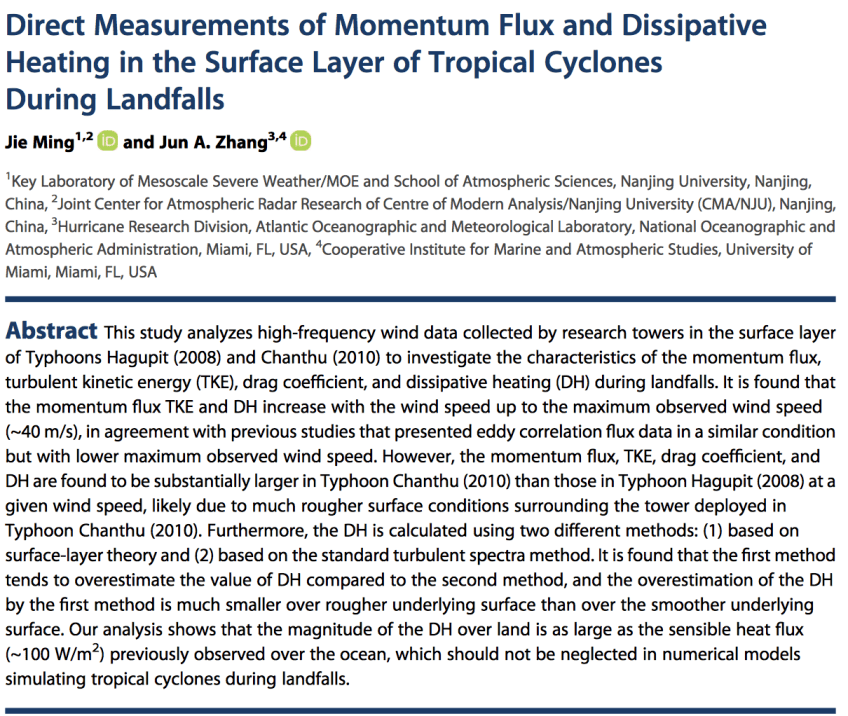

Summary:Friction is what happens when two things rub up against each other; when this happens, they release heat. When this happens in the atmosphere, we call it “dissipative heating.” Tropical cyclones (TCs) mainly gather energy from the warm ocean at the boundary layer, the region from the surface of the ocean to an altitude of […]
August’s science meeting consisted of five presentations: Andrew Kren – HAMSR retrieval assimilation in the GSI system Josh Wadler (UM/RSMAS)- A Characterization of Turbulent Kinetic Energy and its Generation in Idealized Tropical Cyclone Simulations Gus Alaka – The Basin-Scale HWRF: 2018 HFIP Real-Time Demos Miguel Cortez (NERTO intern) – Summer 2018 NERTO update Stan Goldenberg […]


Mr. Ramstrom presented a seminar titled “Damage Rates from Insurance Claims for Coastal and Inland Areas in Hurricanes Harvey and Irma”. ABSTRACT: Insurance claims data provides a highly detailed view of the geographic patterns of damage in hurricanes. This talk will cover analytics that correlate claims percentages with maximum winds and rainfall during the landfalls […]
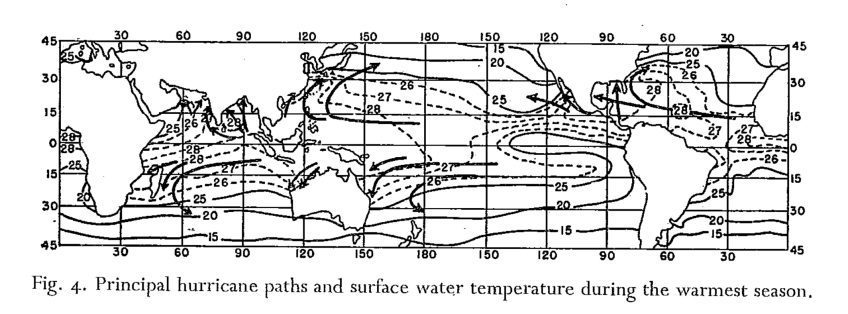
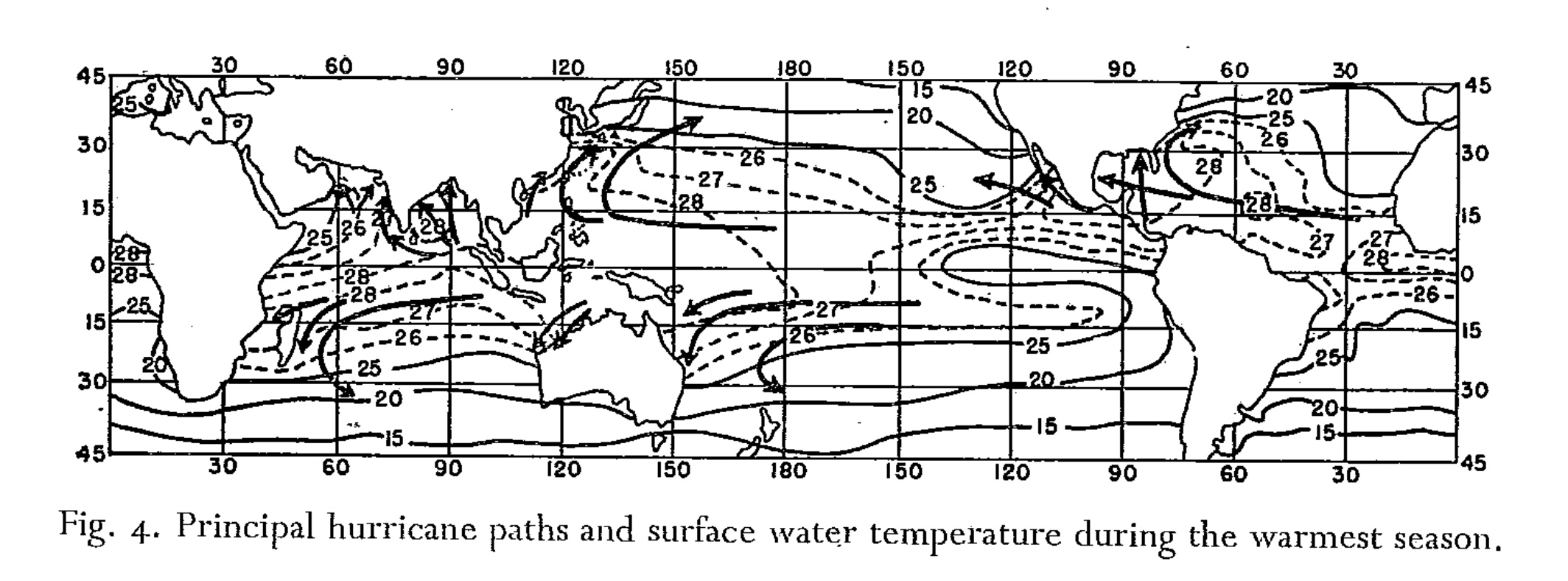
In the summer 1948 edition of Geophysica journal, Eric Palmén published a seminal paper entitled “On the Formation and Structure of Tropical Hurricanes”. In it he proposed that a tropical disturbance needed to be over sea surface temperature of at least 80℉ (26-27℃) in order to form into a tropical cyclone. He imposed the tracks […]
Wednesday, August 8, 2018: NOAA49: The G-IV will return to Lakeland from Honolulu. No further missions are planned. ……………………………………………………………………. For the latest information about tropical cyclones and other weather systems, please visit the NOAA/NWS/National Hurricane Center. To access updates on IFEX and other HRD activities via Facebook, Twitter, or RSS feed, check out the HRD […]


Tuesday, August 7, 2018: NOAA49: The G-IV will conduct a final synoptic surveillance mission around Hurricane Hector. Departure will be from Honolulu at 1730 UTC with recovery in Honolulu about 8 h later. No HRD scientists will be on this flight. Wednesday, August 8, 2018: NOAA49: The G-IV will return to Lakeland from Honolulu. ……………………………………………………………………. […]