Category: Uncategorized

Greater Miami AMS Chapter/HRD Seminar – Brian McNoldy, University of Miami/RSMAS – 10 December 2018

The Greater Miami Chapter of the American Meteorological Society (AMS) held their meeting Monday, December 10, 2018 at the AOML Laboratory.  The featured speaker was Brian McNoldy, University of Miami /RSMAS Senior Research Associate and Capital Weather Gang Tropical Meteorologist. Brian presented a seminar on “The 2018 Hurricane Season in Review”. A copy of the […]

Read Full Article

Paper on the Doppler Wind Lidar, a new instrument to measure wind from hurricane hunter aircraft, published in the journal Sensors

Summary: A new instrument, called an airborne Doppler Wind Lidar (ADWL, for short), was flown on NOAA’s hurricane hunter aircraft into two storms during 2016. This instrument measures winds above and below the plane. The ADWL measures wind where radar on the aircraft cannot: the radar can measure the wind where there are clouds or […]

Read Full Article

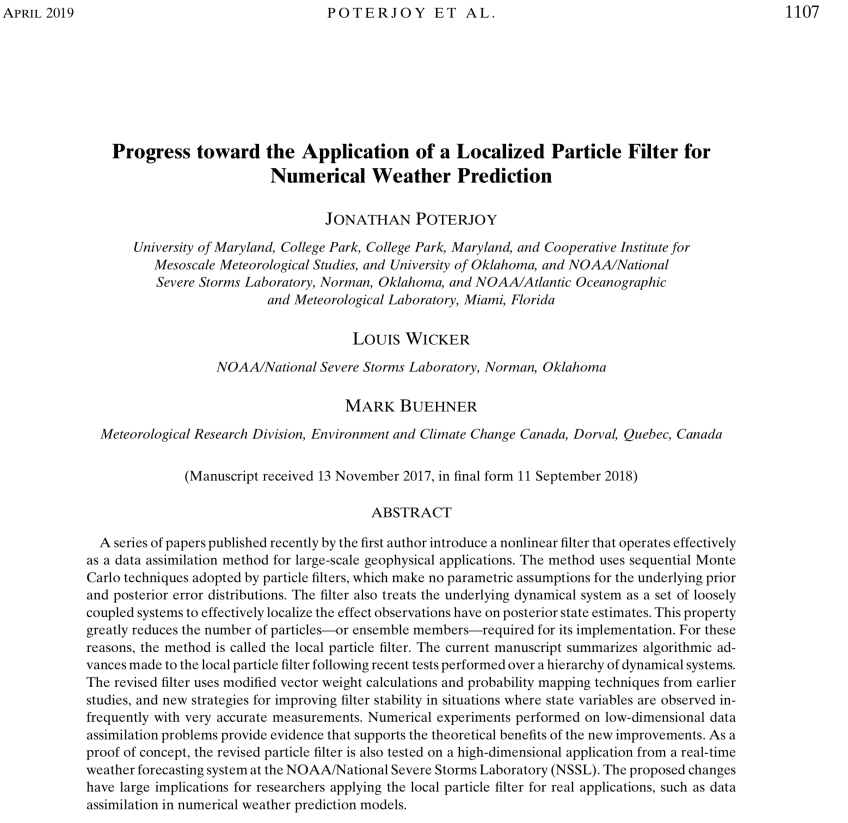
Paper on a new way to input observations into weather models published in Monthly Weather Review

Summary:  Predicting the weather with 100% accuracy is an impossible task. Doing so would require full knowledge of the Earth system (the air, water, land, etc.) including the present state of the atmosphere (its wind, temperature, humidity, etc.). It would also require a complete understanding of everything that causes the weather. In reality, our understanding […]

Read Full Article

Paper on possible improvements to forecasts from additional radio-occultation satellite data published in Monthly Weather Review

Summary: The Constellation Observing System for Meteorology, Ionosphere, and Climate (COSMIC) are a set of satellites that were launched in 2006 and orbit the earth about 500 miles above ground. They use radio signals from Global Positioning System (GPS) satellites in a process called “radio occultation” to measure temperature and moisture with high accuracy every 100 […]

Read Full Article

Paper on the impact of using Hurricane Hunter data in the HWRF model published in Monthly Weather Review

We studied how Hurricane Hunter aircraft observations can improve tropical cyclones forecasts from the National Oceanic and Atmospheric Administration’s Hurricane Weather Research and Forecast (HWRF) model. Important Conclusions: Hurricane Hunter aircraft data generally improve HWRF forecasts. These improved forecasts are mainly in weak storms, since, without the data, HWRF often forecast storms that are too […]

Read Full Article

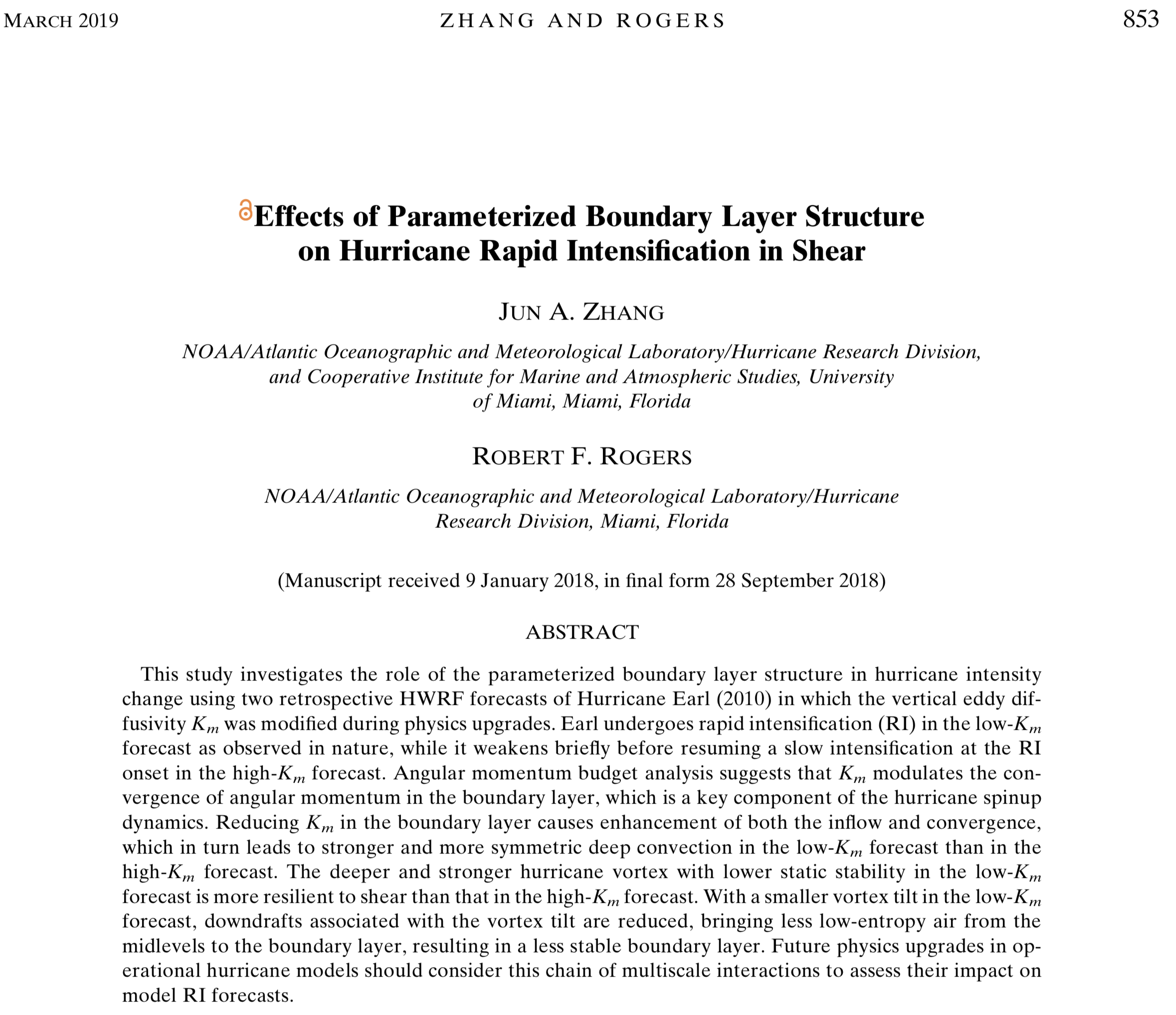
Paper on how getting turbulence correct in forecast models can improve intensity forecasts in sheared storms published in Monthly Weather Review

Summary:  Though tropical cyclones (TCs) are usually hundreds of miles across, the strongest wind occurs in gusts that can be smaller than 100 yards across, or the size of a football field. We call features that cover such a small area the “turbulent scale.” Other features that are important in forecasting TCs can be as […]

Read Full Article