Paper on different pathways to tropical cyclone intensity changes published in Earth and Space Science
Read the full manuscript at https://agupubs.onlinelibrary.wiley.com/doi/full/10.1029/2019EA000585.
Read the full manuscript at https://agupubs.onlinelibrary.wiley.com/doi/full/10.1029/2019EA000585.


The American Meteorological Society has announced that Dr. Jun Zhang, Dr. David S. Nolan, Dr. Robert F. Rogers, and Dr. Vijay S. Tallapragada have won the 2020 Banner I. Miller Award for their paper, “Evaluating the impact of improvements in the boundary layer parameterization on hurricane intensity and structure forecasts in HWRF,” which significantly advanced […]

Kelly presented a seminar titled “PV budget analysis on high resolution simulations to understand the interaction of AEWs with associated convection”. Abstract: The role of convection and associated potential vorticity (PV) generation have been shown to be significant in the evolution of African Easterly Waves (AEWs); however, how the evolving AEWs lead to tropical cyclogenesis […]
July’s science meeting consisted of two presentations: Hua Leighton: Revisit of Microphysics Observation Paige Brown (Stanford University): Low-cost, Altitude Controlled Latex Balloon for Mapping Atmospheric Data The two presentations are available on the anonymous ftp site at: ftp://ftp.aoml.noaa.gov/hrd/pub/blog/meetings/2019/Science/HRD_SciMeet_20190711.zip
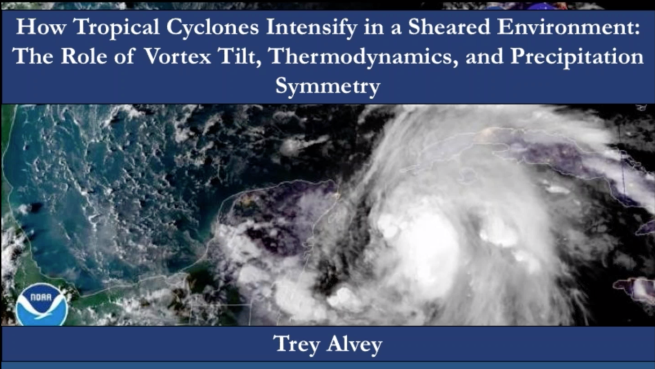
Trey presented a seminar titled “How do sheared tropical cyclones evolve towards symmetry before rapid intensification?” ABSTRACT: In seemingly similar environments, some moderately sheared tropical storms undergo rapid intensification (RI) evolving towards more symmetrical precipitation structures but others do not. What role do the vortex tilt, humidification, and precipitation symmetry play in helping distinguish those […]


Read the article at https://www.usatoday.com/story/news/nation/2019/07/10/hurricanes-july-happen-look-past-storms/1694664001/


A NOAA P-3 (“Kermit”) mission into Tropical Storm Barry this morning successfully sampled the structure of the storm and completed data collection objectives for NOAA/NCEP Environmental Modeling Center (EMC). Shown below, they completed a rotated Figure 4 pattern, four passes through the center, dropping dropsondes throughout the pattern and collecting valuable Doppler radar data. The […]

The second EMC-tasked NOAA P-3 (NOAA 42, aka “Kermit”) mission into Tropical Storm Barry successfully completed their flight objectives this morning, landing back in Lakeland, FL around 11 am EDT. Below shows the completed flight pattern, in which the crew flew a “butterfly” pattern sampling multiple legs through the developing center of the storm. After the […]

The first NOAA P-3 mission of the 2019 hurricane season is scheduled to take off from Lakeland, FL at 4 pm EDT (2000 UTC) this afternoon to sample Potential Tropical Cyclone Two in the northeastern Gulf of America. The P-3 “Kermit” (NOAA42) will fly a lawnmower pattern (shown below) to collect data for NOAA’s National […]