Paper on the height of the layer nearest the surface in hurricanes and how it changes with storm motion published in the journal Atmosphere
You can read the study at https://www.mdpi.com/2073-4433/10/6/339
"
You can read the study at https://www.mdpi.com/2073-4433/10/6/339
October’s science meeting consisted of seven presentations: Sim Aberson – “A comparison of SAMURAI, HEDAS, and radar analyses for Hurricane Patricia (and a sneak peek into Dorian)” Lisa Bucci – “Understanding the response of tropical cyclone structure to the assimilation of synthetic wind profiles” Hui Christophersen – “TROPICS Radiance OSSE Update” Xiaomin Chen – “A […]
You can read it at https://www.frontiersin.org/articles/10.3389/fmars.2019.00443/full
Read the full article at https://journals.ametsoc.org/doi/pdf/10.1175/MWR-D-18-0380.1,
Read the paper at https://www.frontiersin.org/articles/10.3389/fmars.2019.00446/full
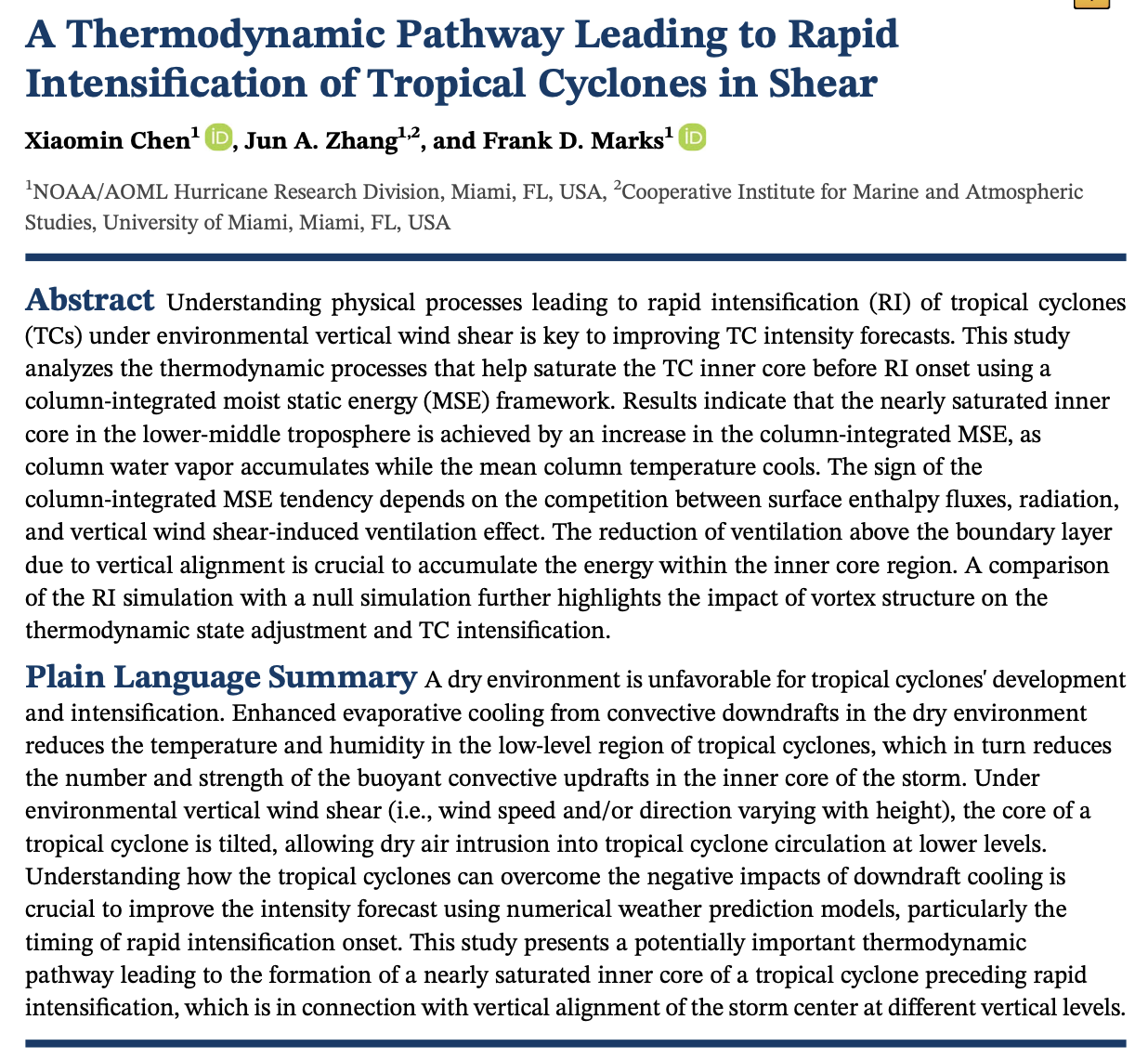
Summary: Tropical cyclones (TCs) are made up of thunderstorms (what we call convection), and these storms have strong winds moving up and down (what we call up- and downdrafts). Dry air enhances evaporative cooling (the same process that cools people when they sweat) from convective downdrafts, reducing the temperature and humidity in low levels; this […]
You can find the study at https://agupubs.onlinelibrary.wiley.com/doi/abs/10.1029/2019JC015153?af=R.
Summary: This study looks at differences between tropical cyclones that strengthen and those that do not using data collected by dropsondes, small instruments released from hurricane hunter aircraft that measure wind, temperature, and moisture as they fall to the surface. Important Conclusions: 1. The fuel that supports tropical cyclones is the heat and moisture from […]
Summary: During each hurricane season, NOAA’s Gulfstream-IV (G-IV) Hurricane Hunter aircraft measures wind, temperature, humidity, and pressure in and around hurricanes threatening the United States. An instrument called the dropwindsonde is released from the G-IV to collect the data as it falls to the ocean surface. The plane currently flies where we expect observations from the […]
All three NOAA aircraft flew in and around Hurricane Lorenzo today, with both P3s flying the same tracks (at 8 and 10 kft) through the storm within 15 minutes of each other. The G-IV departed the storm just as the P3s were entering. The G-IV flew an HRD research mission in support of the NESDIS […]