Category: Uncategorized

AOML hurricane scientists observe Hurricane Zeta’s re-intensification in Gulf of America

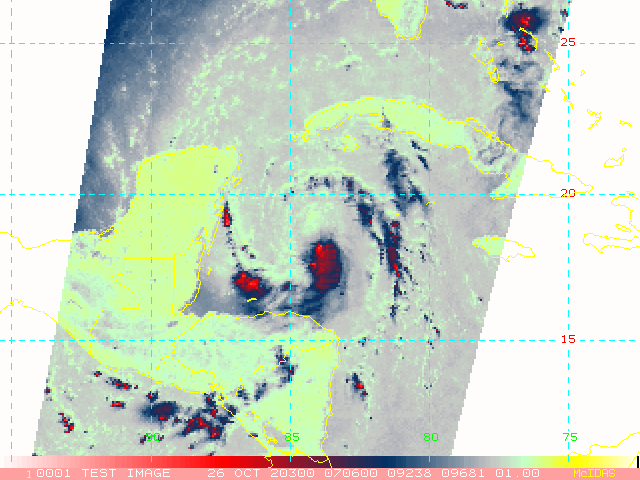
Tasked by both the National Hurricane Center (NHC) and the Environmental Modeling Center (EMC), NOAA aircraft reconnaissance continues into Hurricane Zeta on October 28, with routine missions taking off from Lakeland, FL at 4 AM EDT.  Hurricane scientists supporting these flights assessed Zeta’s wind and precipitation characteristics as the circulation emerged over water after making […]

Read Full Article

Lidia Cucurull appointed NOAA Lead for one of the strategic goals of the NASA-NOAA Modeling Collaboration

Dr. Lidia Cucurull, Supervisory Physical Scientist with NOAA’s Atlantic Oceanographic and Meteorological Laboratory, has been appointed the NOAA lead for Goal 2 of the NASA-NOAA Modeling Collaboration. The goals of the Collaboration are to coordinate and focus initiatives and establish a mechanism to transfer important research to operations for Earth Science (including weather) and Space […]

Read Full Article

NOAA continues flights into Tropical Storm Zeta

NOAA P-3 and G-IV aircraft continued flights in and around Tropical Storm Zeta over the weekend at the request of the National Hurricane Center (NHC).  AOML scientists supported missions by quality controlling and transmitting data from the Tail Doppler Radar and dropsondes.  Data were used by NHC forecasters to understand the current structure of the […]

Read Full Article

Paper on the relationship between the amount of ice in clouds and rapid intensification of hurricanes published in Geophysical Research Letters

Summary:  It is difficult to accurately forecast how strong a tropical cyclone will get, what we call intensity. The biggest problem is in forecasting when the intensity increases dramatically in a short period of time, or rapid intensification (RI).  This study looked at the relationship between how fast a tropical cyclone intensifies and the amount […]

Read Full Article

Study on how different techniques to model the hurricane boundary layer can improve forecasts published in Atmosphere

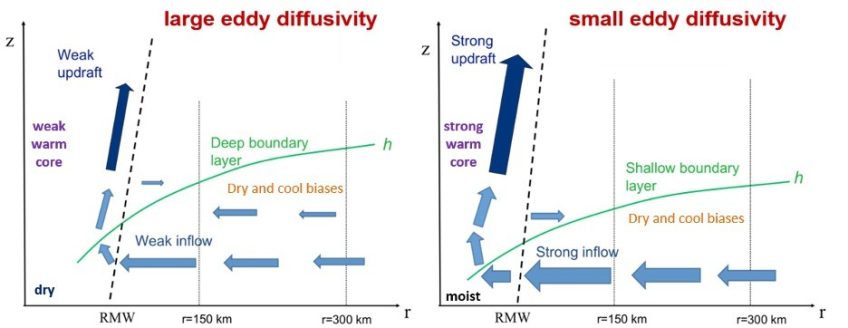
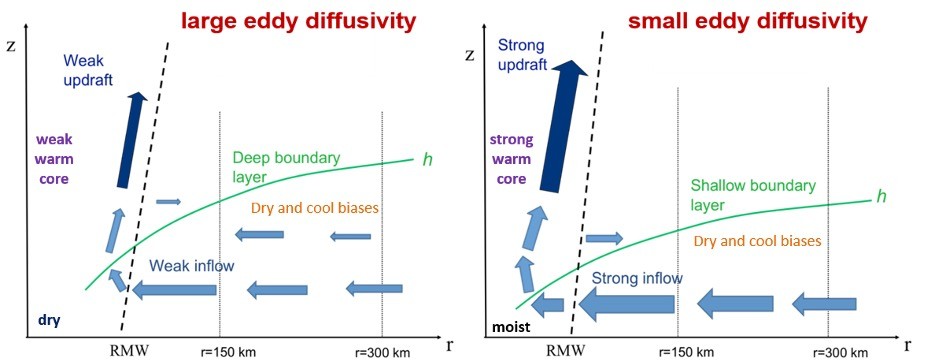
In a new study published in Atmosphere, hurricane scientists looked at how turbulent mixing in the boundary layer affects the intensity and structure of hurricanes in NOAA’s Hurricane Weather Research and Forecasting (HWRF) model. They found that turbulent mixing affects where thunderstorms in hurricanes occur, and how fast air flows towards the center of a storm. Read […]

Read Full Article

AOML Scientists wrap up map discussions for the 2020 Atlantic hurricane season

AOML scientists and collaborators met every weekday between mid-July through mid-October of the Atlantic hurricane season to discuss the tropical forecast and potential opportunities to conduct research.  The final week of discussions was led by Kelly Ryan of the Cooperative Institute for Marine and Atmospheric Sciences at the University of Miami. The primary topic of discussion in […]

Read Full Article

HRD Monthly Science Meeting of October 2020

Because of ongoing Hurricane Delta missions October’s science meeting consisted of only one presentation:  Kathryn Sellwood – HRDOBS: A Comprehensive, Research Quality Tropical Cyclone Centered Data Set The presentation is available on the anonymous ftp site at: ftp://ftp.aoml.noaa.gov/hrd/pub/blog/meetings/2020/Science/HRD_SciMeet_20201008.zip

Read Full Article