CIMAS celebrates its achievements with awards ceremony
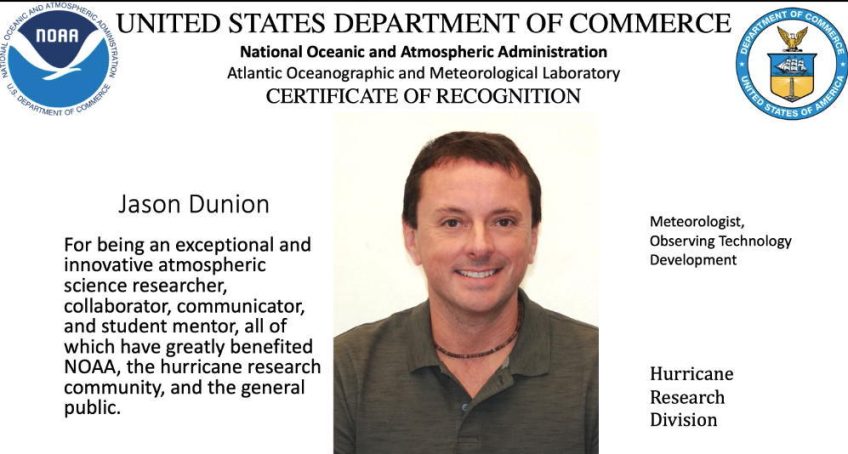
The Cooperative Institute for Marine and Atmospheric Studies, a NOAA Center of Excellence responsible for carrying out much of the basic research in NOAA, held an awards ceremony on 11 February to celebrate individual and group accomplishments during the past year and a half. About half of those who work inside the AOML building on […]
A better way to get GPS radio occultation into forecast models published in Monthly Weather Review
■ Summary: The Constellation Observing System for Meteorology, Ionosphere, and Climate (COSMIC) are a set of satellites launched in 2006 that orbit the earth about 500 miles above ground. They use radio signals from Global Positioning System (GPS) satellites in a process called “radio occultation” to measure temperature and moisture with high accuracy. These data […]
AOML Hurricane Scientists Facilitate Leap in Hurricane Modeling and Prediction Systems
Hurricane scientists at NOAA’s Atlantic Oceanographic and Meteorological Laboratory have created a new, advanced moving nest system within the Unified Forecast System, the bedrock of NOAA’s weather prediction applications. AOML’s Hurricane Modeling and Prediction Team developed the high-resolution moving nest for the FV3 dynamical core, laying the foundation for next-generation advancements in hurricane forecasting. Continue reading at https://www.aoml.noaa.gov/news/scientists-facilitate-leap-in-modeling-prediction/.
Paper about how a new forecast model for hurricanes performed during 2019 published in Weather and Forecasting
This paper summarizes forecasts from an experimental forecast model called the Hurricane Analysis and Forecast System (HAFS) made during the 2019 Hurricane Season. HAFS is being developed for future use as an operational hurricane model to help forecasters predict what a hurricane is going to do. HAFS forecasts the weather on a set of points […]
HRD scientists participate in the 101st American Meteorological Society Annual Meeting
The Annual Meeting is the world’s largest yearly gathering for the weather, water, and climate community. It brings together great minds from a diverse set of scientific disciplines – helping attendees make career-long professional contact and life-long friends while learning from the very top people in the atmospheric sciences. The 101st AMS Annual Meeting took place virtually […]
Paper on the accuracy of an experimental airborne instrument to measure temperature and humidity published in Atmospheric and Oceanic Technology
The Global Hawk, a drone or autonomous aircraft system, has been used since 2010 to gather data to improve weather forecasts. The Global Hawk releases dropsondes that measure temperature, pressure, humidity, and wind up to four times every second between 60,000 feet and the surface, providing thousands of measurements. The Global Hawk also has the […]
Paper on forecasting how raindrops, snowflakes, and ice form, grow, and fall published in Monthly Weather Review
Summary: Tropical cyclones (TCs) are made up of clouds and thunderstorms, and thus drop large amounts of rain. The clouds are made up of cloud particles such as raindrops, snowflakes, and ice. Knowledge of the ways these particles form, grow, and fall (what we call cloud microphysics) is very important for accurate TC rainfall forecasts, […]
Study on the the structure of water and ice particles in tropical cyclones published in Monthly Weather Review
Read the study at https://journals.ametsoc.org/view/journals/mwre/aop/MWR-D-20-0111.1/MWR-D-20-0111.1.xml. For more information, contact aoml.communications@noaa.gov.
Study on the rapid intensification of Hurricane Dorian near the Eastern Caribbean published in Atmosphere
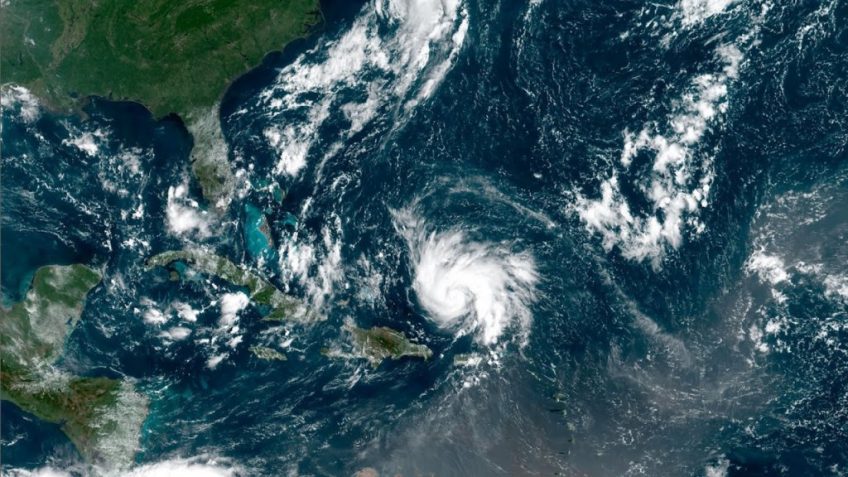
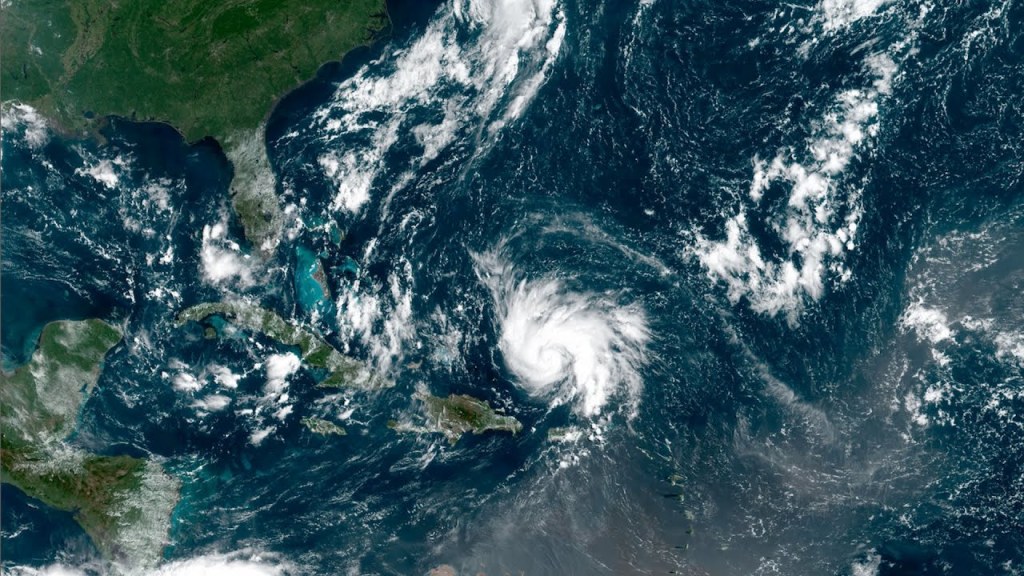
Summary: We look at why Hurricane Dorian was able to intensify in the Eastern Caribbean when many forecasts suggested that it would stay weak and perhaps die out. To help answer this question, we use a forecast model called the Hurricane Analysis and Forecast System (HAFS). Specifically, we use an ensemble, a group of forecasts […]