Jason Dunion highlighted by CIMAS
Check out the Spotlight profile of Jason at https://cimas.rsmas.miami.edu/news-events/spotlights/jason-dunion/index.html.
Check out the Spotlight profile of Jason at https://cimas.rsmas.miami.edu/news-events/spotlights/jason-dunion/index.html.

This review article highlights recent research from NOAA/AOML/Hurricane Research Division’s Hurricane Field Program – Intensity Forecasting Experiment (IFEX) geared to improving our understanding and forecasting of tropical cyclones (TCs). It details the accomplishments of IFEX during the 16 years of its existence, for example • describing how IFEX addressed important issues like predicting rapid intensification […]


NOAA conducted six flights into Hurricane Elsa earlier in July, four with the P3s and two with the G-IV. The G-IV operational synoptic flow missions were conducted to gather information from high-levels of the atmosphere around Elsa to improve model forecasts of the storm’s track and intensity. The P3 missions were conducted to gather data […]


The storymap includes work on the Hurricane Analysis and Forecasting System (HAFS), a set of moving, high-resolution nests around tropical cyclones in the global weather model, and the AOML Hurricane Model Viewer. View there storymap at https://storymaps.arcgis.com/stories/17d9393d307449a3a46fa3aa6dd5e258. For more information, contact aoml.communications@noaa.gov. Credits: The Supplemental Program Team is managed by the NOAA Line Offices of: […]


For more information, contact aoml.communications@noaa.gov. The paper can be accessed at https://agupubs.onlinelibrary.wiley.com/doi/epdf/10.1029/2020EA001402.

You can read the study at https://www.mdpi.com/2073-4433/12/4/492.

You can read the paper at https://rmets.onlinelibrary.wiley.com/doi/epdf/10.1002/qj.4034.

Read the full paper at https://www.mdpi.com/2073-4433/12/6/683.

The full paper can be found at https://doi.org/10.1175/MWR-D-20-0368.1.poterj
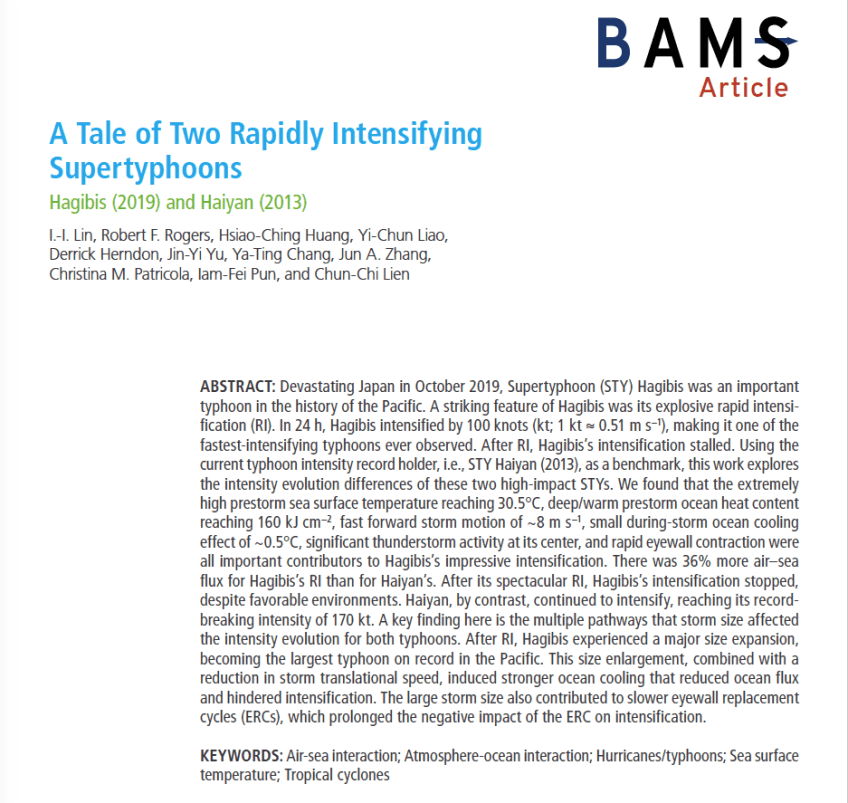

For more information, contact aoml.communications@noaa.gov. The article is available at https://doi.org/10.1175/BAMS-D-20-0223.1. The authors thank the US NCEP, JTWC, NRL, the Remote Sensing Systems, NOAA NESDIS, the European Union’s Copernicus and the AVISO team, and theArgo team for providing essential data sets. I.-I. L. acknowledges support from the Ministry of Science and Technology, Taiwan. R. R. […]