Paper on the impact of changing vertical resolution in the operational HWRF published in Monthly Weather Review
The paper can be accessed at http://journals.ametsoc.org/doi/pdf/10.1175/MWR-D-14-00102.1.
The paper can be accessed at http://journals.ametsoc.org/doi/pdf/10.1175/MWR-D-14-00102.1.

A long-term (1996–2012), high-quality, high vertical resolution (∼5–15 m) GPS dropsonde dataset is created from NOAA Hurricane flights and consists of 13,681 atmospheric profiles for 120 tropical cyclones. The paper can be accessed at http://journals.ametsoc.org/doi/abs/10.1175/BAMS-D-13-00203.1.

HRD researchers discussed the results from the 10 P-3, 3 G-IV, and 2 Global-Hawk missions into Hurricane Danny and Tropical Storm Erika. The agenda for the discussion was: Overview of missions (Rogers) Accomplishments Science objectives and opportunities Hurricane Danny (5 P-3 and 2 G-IV mission) TC in shear (Reasor) Tropical Storm Erika (5 P-3, 1 […]

On September 10, 1945, Typhoon Ursula downed a fleet of 6 US aircraft transporting liberated prisoners of war to the Philippines. The planes were flying from Okinawa to the Philippines, as part of a larger effort to repatriate 32,000 Allied war prisoners, and attempting to skirt Ursula. But they still encountered rough weather associated with […]

On September 9, 1950, the first storm name appeared in an official US Weather Bureau (USWB) bulletin for an Atlantic tropical cyclone. A tropical storm had formed 2000 miles east of the Lesser Antilles the day before. The USWB had just been dealing with three hurricanes churning simultaneously in various parts of the Atlantic basin […]

Annette presented a seminar “Radar-Derived Buoyancy and its Role in Hurricane Intensity Change“. ABSTRACT: Ordinary tropical convection is generally forced by positive buoyancy, but rotational forces and a strengthening warm core play a progressively important role in organizing convection as a TC intensifies. Axisymmetric conceptual and numeric models of the eyewall are characterized by moist neutral […]

On September 9, 1775, a violent hurricane swept over the British colony of Newfoundland. It sank many fishing boats and two British naval vessels to become the deadliest hurricane to strike Canada (and one of the top ten deadliest Atlantic hurricanes). It was also the first one in Canada’s recorded history. The week before, a […]

On the evening of September 8, 1900, a major hurricane struck Galveston, Texas. It became the deadliest hurricane to hit the United States and altered the city forever. The disturbance that formed the hurricane was first detected on August 27th by ships a thousand miles east of the Antilles. It moved steadily westward and crossed […]
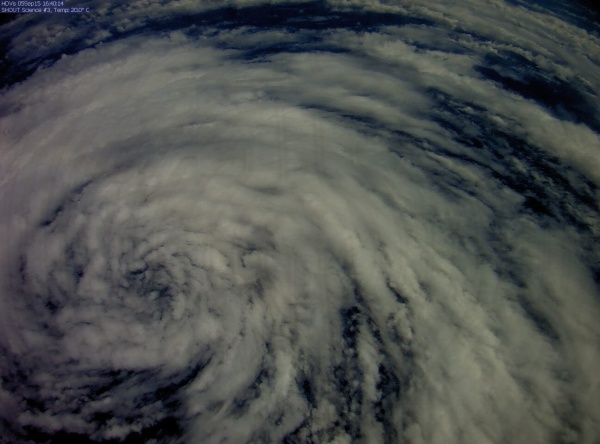
The Global Hawk continues to fly over Fred. Here’s a spectacular view of Fred from one of the cameras on the unmanned aircraft.

The unmanned aircraft, the Global Hawk took off at 6:50 AM Eastern this morning from Wallops Island, VA headed to fly over Fred. It will fly across the Atlantic Ocean to reach Fred. As part of NOAA’s Sensing Hazards with Operational Unmanned Technology (SHOUT) field campaign the Global Hawk will collect data throughout the 24 hour mission. It will […]