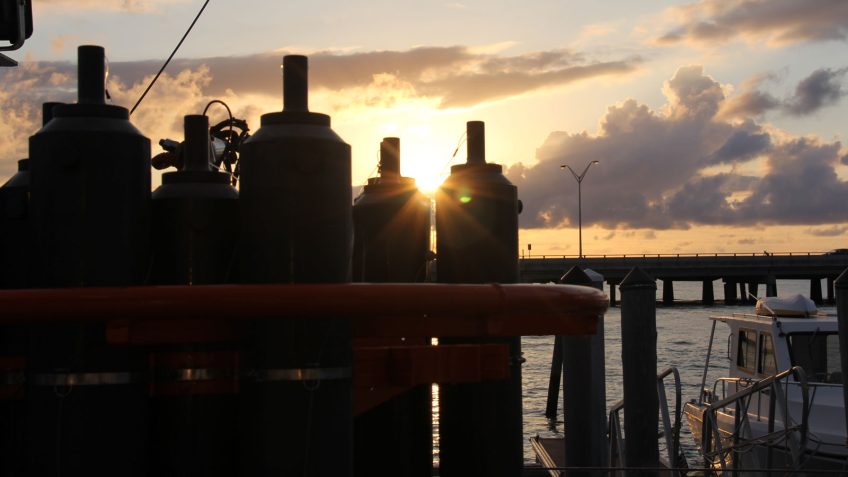
Scientists at NOAA’s Atlantic Oceanographic & Meteorological Laboratory (AOML) and the Cooperative Institute for Marine and Atmospheric Studies (CIMAS) have successfully overseen the first-ever crossbreeding between grooved brain corals (Diploria labyrinthiformis) collected from a highly urbanized site in PortMiami and a nearby reef – a breakthrough that could revolutionize efforts to restore local coral reefs.
Read Full Article
Jen McWhorter, Ph.D., a Cooperative Institute for Marine and Atmospheric Science (CIMAS) Assistant Scientist with AOML’s Ocean Biogeochemistry and Physical Oceanography teams, has been selected to serve a one year term as a member of the NOAA in the Caribbean Executive Team. As a member of the Executive Team, McWhorter will help provide strategic direction […]
Read Full Article
Phytoplankton covering the ocean’s surface are responsible for over 50% of the oxygen that has been produced on Earth. In a spoonful of oceanwater, there are thousands of these microscopic organisms of different species. And without them, most – if not all – marine food webs would collapse. Studying what species comprise planktonic communities in […]
Read Full Article
Stony Coral Tissue Loss Disease (SCTLD) is the deadliest known coral disease to species with a hard skeleton (i.e., Scleractinians), causing rapidly-expanding, bare lesions to form across a coral’s skeleton until there is no more living tissue. The pathogen or microbes leading to the spread of this disease have yet to be identified. Yet scientists […]
Read Full Article
The ocean and the atmosphere are constantly seeking balance. Gases like oxygen, nitrogen, and carbon move between the ocean’s surface and the atmosphere by billions of metric tons every year. A higher concentration of one gas in the atmosphere leads to more of that gas being taken up by the ocean as the two try […]
Read Full Article
Water masses move over reefs, seagrass beds, and sandbanks – and as they do, the seawater chemistry changes. In the Florida Keys, changes in coral reef carbonate chemistry are driven by benthic metabolism, the origin of the water mass, and the connectivity of habitats. A new study from NOAA’s Atlantic Oceanographic and Meteorological Laboratory (AOML) […]
Read Full Article
After nearly 40 days at sea, the I09N GO-SHIP cruise (short for “Global Ocean Ship-based Hydrographic Investigations Program”) aboard the R/V Thomas G. Thompson arrived in Phuket, Thailand on April 27th, successfully completing its mission surveying both the Indian Ocean and Bay of Bengal. After departing from Fremantle, Australia on March 21st, the international team of researchers spent weeks collecting data essential for investigating global changes in ocean physics, chemistry, and biology.
Read Full Article
Research Highlights September 21, 2026A new study investigates oil-degrading microbes a year before Deepwater Horizon Oil SpillSeptember 18, 2026The Great Miami Hurricane of 1926September 11, 2026A New Collaboration to investigate the ocean’s natural accumulation of carbon Research Interests Evan Josza Research Associate (University of Miami/CIMAS), Ocean Chemistry and Ecosystems Division evan.josza@noaa.gov 4301 Rickenbacker Causeway Miami, [...]
Read Full Article
For the past three years, scientists at NOAA’s Atlantic Oceanographic and Meteorological Laboratory (AOML) and the Cooperative Institute for Marine and Atmospheric Science have been uncovering the secrets behind the extraordinary resilience of corals in PortMiami. Now, you can dive into their groundbreaking research like never before with a new virtual reality experience, Unlocking the […]
Read Full Article
South Florida is comprised of 350 miles of the only barrier coral reef in North America – and the third largest in the world. 1,800 miles of shoreline is lined with mangroves in the Florida Keys alone, which provide coastal protection from storms and support juveniles of commercialized fish species. The region sustains the largest […]
Read Full Article