Dinámica y Física
Comprender la estructura e intensidad de los ciclones tropicales
DESPLÁCESE PARA SABER MÁS
Quiénes somos
El potencial destructivo de un huracán se rige por su interacción con el medio ambiente y los procesos físicos internos de la tormenta. Los investigadores del AOML utilizan diversas herramientas para comprender mejor cómo interactúan los fenómenos desde la escala ambiental más amplia hasta la escala de las nubes y las turbulencias (interacciones multiescala) para producir esos cambios.
También colaboramos estrechamente con científicos de otras disciplinas para mejorar las herramientas disponibles y aplicar los nuevos conocimientos de manera que beneficien la predicción y mejoren las previsiones.
Objetivo
Nuestro objetivo es mejorar nuestra comprensión de la estructura de los ciclones tropicales y del cambio de intensidad mediante la aplicación de principios físicos fundamentales.






Noticias principales
Early-career meteorologist, Jason Dunion, is a recipient of the prestigious PECASE award
February 19, 2025
Jason Dunion, Ph.D. – a Cooperative Institute for Marine and Atmospheric Studies (CIMAS) meteorologist affiliated with NOAA’s Atlantic Oceanographic and Meteorological Laboratory (AOML) – has been awarded the Presidential Early Career Award for Scientists and Engineers (PECASE), the most prestigious award granted by the U.S. government to exceptional scientists and engineers in the early stages […]


Leer más noticias
Componentes de la interacción multiescalar
Entorno de la tormenta
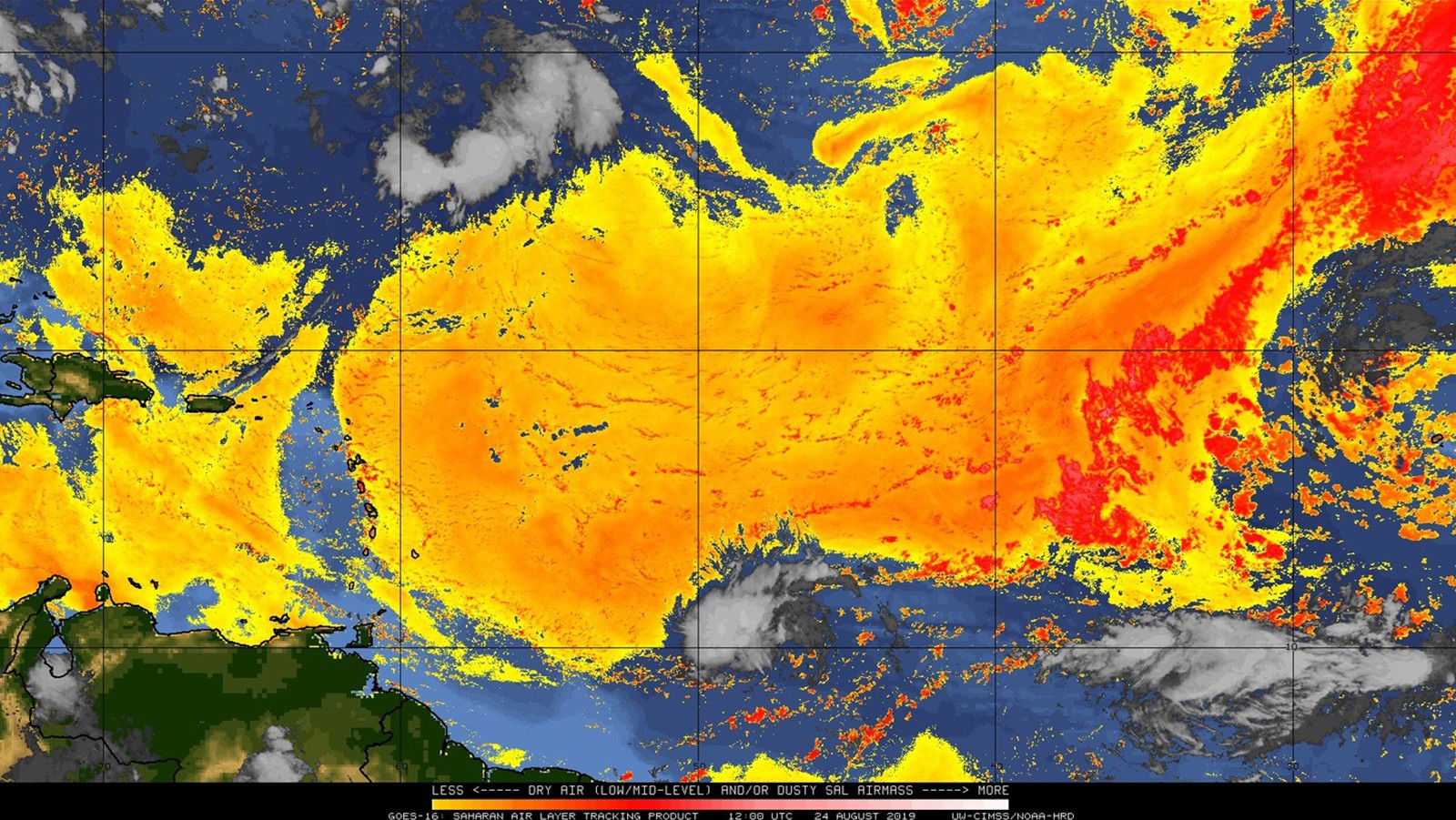
Un huracán se desarrolla en una atmósfera caracterizada por la evolución de distribuciones de humedad y viento a gran escala, y sobre un océano con una distribución de temperatura que evoluciona más lentamente. La atmósfera y el océano que rodean al huracán se denominan
el entorno de la tormenta. Dado que el entorno de la tormenta interactúa con el huracán, es importante caracterizarlo y comprenderlo.
Interacciones tormenta-ambiente
La interacción entre un ciclón tropical (ya sea un huracán, una tormenta tropical, una depresión tropical o una pre-depresión) y el entorno que encuentra desempeña un papel fundamental a la hora de determinar si la estructura y la intensidad de la tormenta cambiarán.
Procesos internos de la tormenta
Son procesos físicos que pueden operar independientemente del entorno de la tormenta, o "internamente". Entre otros impactos, suelen estar asociados a cambios drásticos a corto plazo en el tamaño y la intensidad de las tormentas, y son responsables de vientos intensos localizados.
Construir una nación preparada para la meteorología.
Comprender la formación de los huracanes.
Leer "Procesos de precipitación y alineación de vórtices durante la intensificación de un ciclón tropical débil en cizalladura vertical moderada".
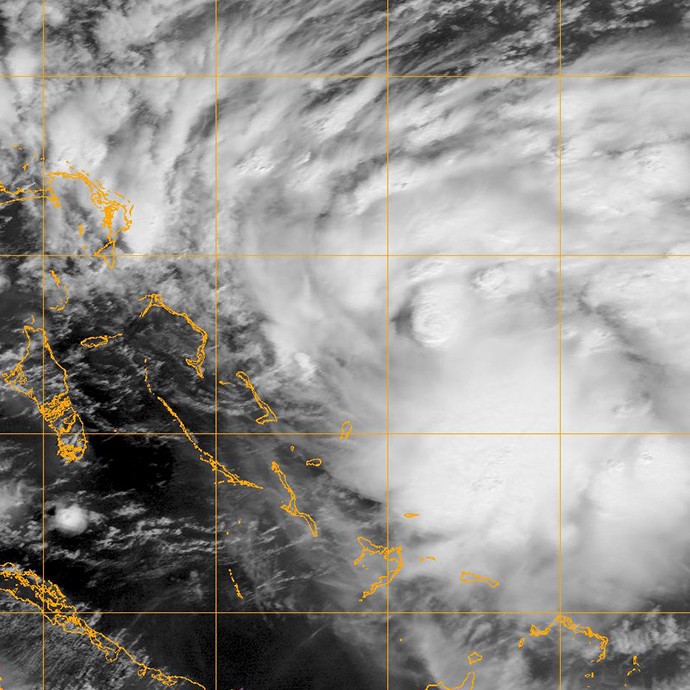
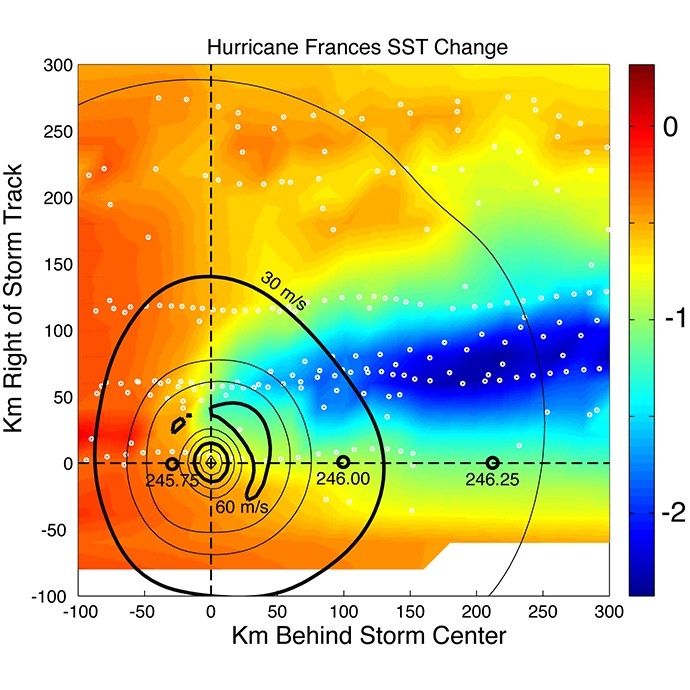
Comprender la formación de un huracán es fundamental para preparar a las comunidades costeras antes de que el mal tiempo amenace nuestras costas. Nuestros científicos estudian esta cuestión observando cómo estos patrones meteorológicos cambian y maduran en su entorno desde la pequeña hasta la gran escala. Lea las últimas investigaciones a continuación.
Alineación de vórtices
Las tormentas luchan por intensificarse cuando sus circulaciones no están alineadas entre los niveles inferiores y superiores de la atmósfera, lo que suele ocurrir cuando se encuentran con cizalladura vertical del viento. Los científicos especializados en huracanes del AOML investigan cómo estas tormentas pueden alinearse e intensificarse, incluso en presencia de este entorno de viento hostil.
Procesos de precipitación
La estructura de la precipitación (lluvia) y cómo se distribuye alrededor de la tormenta puede desempeñar un papel importante a la hora de determinar si la tormenta se intensificará o no. Los científicos del AOML investigan cómo cambia la estructura y la distribución de la precipitación en relación con el entorno de la tormenta para permitir su intensificación.
Recuperación de la capa límite planetaria
Las precipitaciones pueden traer aire frío y seco a la capa límite, limitando de forma efectiva el desarrollo de fuertes tormentas en la circulación de la tormenta. Los científicos del AOML estudian cómo la capa límite puede recuperarse en presencia de la cizalladura vertical del viento para permitir un nuevo desarrollo de las tormentas y su intensificación.
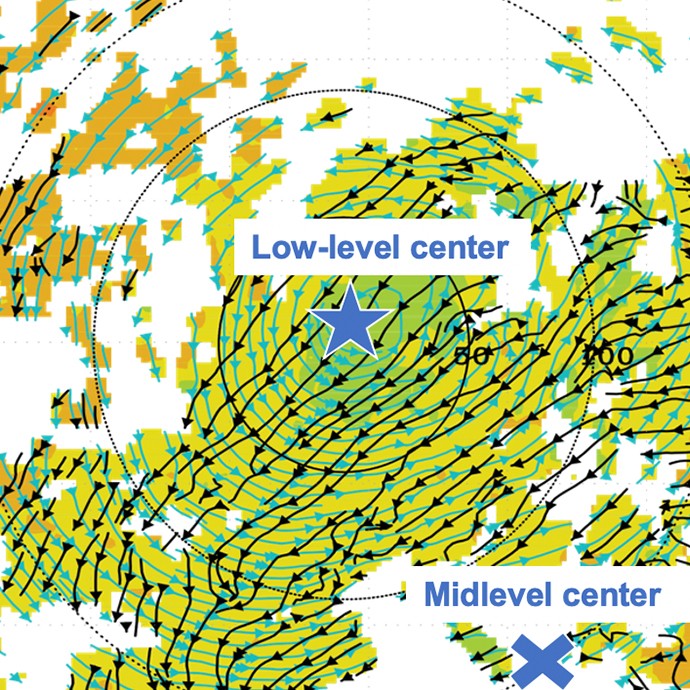
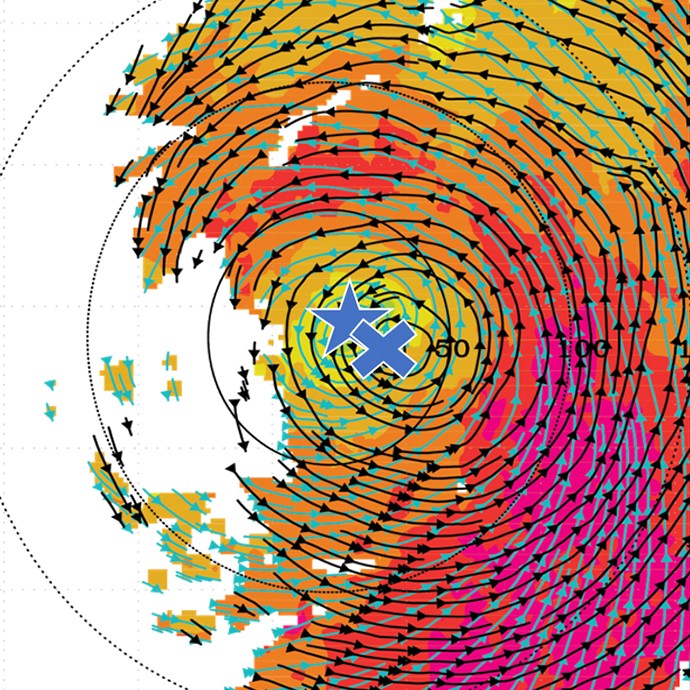
Deslizamiento para ver el vórtice alineado frente al no alineado
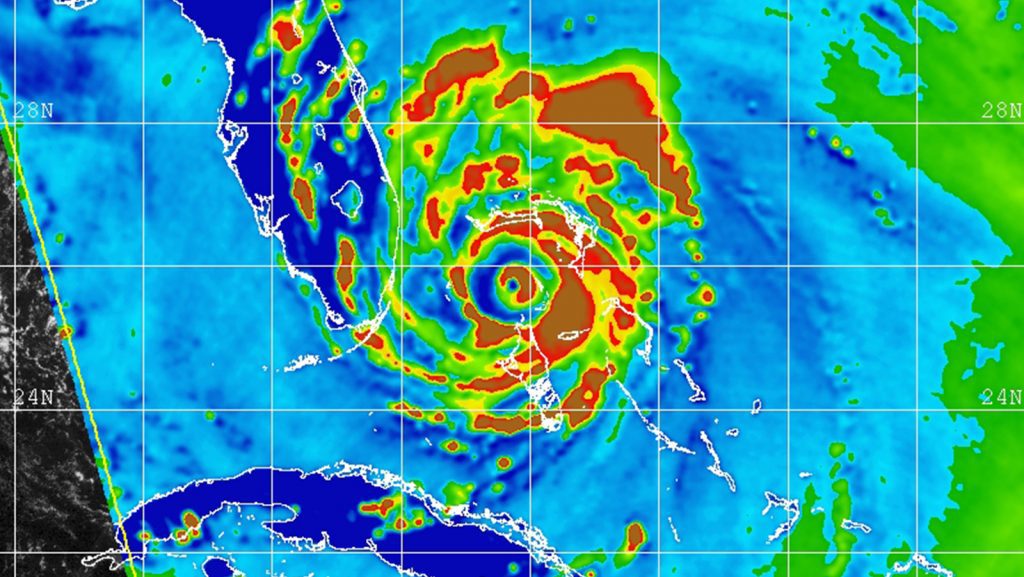
Formación de la pared ocular secundaria
Los huracanes intensos suelen desarrollar las llamadas paredes oculares secundarias fuera de la pared ocular primaria inicial. Los científicos de huracanes del AOML investigan cómo se forman estas paredes oculares secundarias y su impacto en la intensidad del huracán.
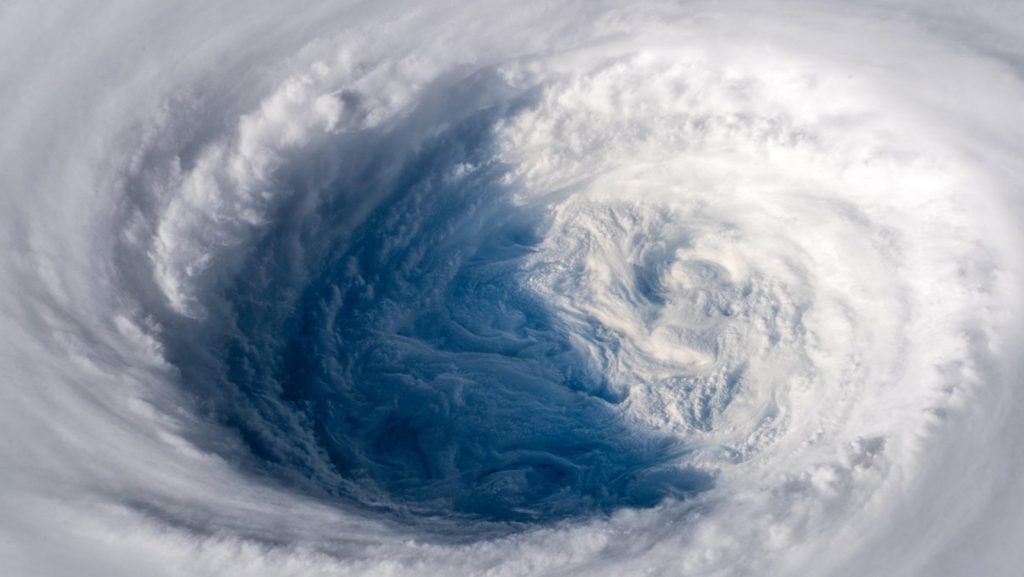
Mezcla de paredes oculares
Una pared ocular que, por lo demás, es circular, puede transformarse en una mezcla dinámica de bandas en espiral y remolinos intensos localizados. Los científicos especializados en huracanes del AOML investigan cómo estas estructuras de menor escala afectan a la intensificación de los huracanes.

Dinámica de la capa límite planetaria
La capa del flujo del huracán más cercana a la superficie del océano se caracteriza por su movimiento turbulento. Los científicos del AOML estudian cómo pueden representarse los efectos de la turbulencia en los modelos que no pueden simular los movimientos turbulentos. También estudian cómo la turbulencia contribuye a la intensificación de los huracanes.
Programa de Campo de Huracanes
Impulsamos la ciencia innovadora.
Diseño experimental y el programa de campo de los huracanes.
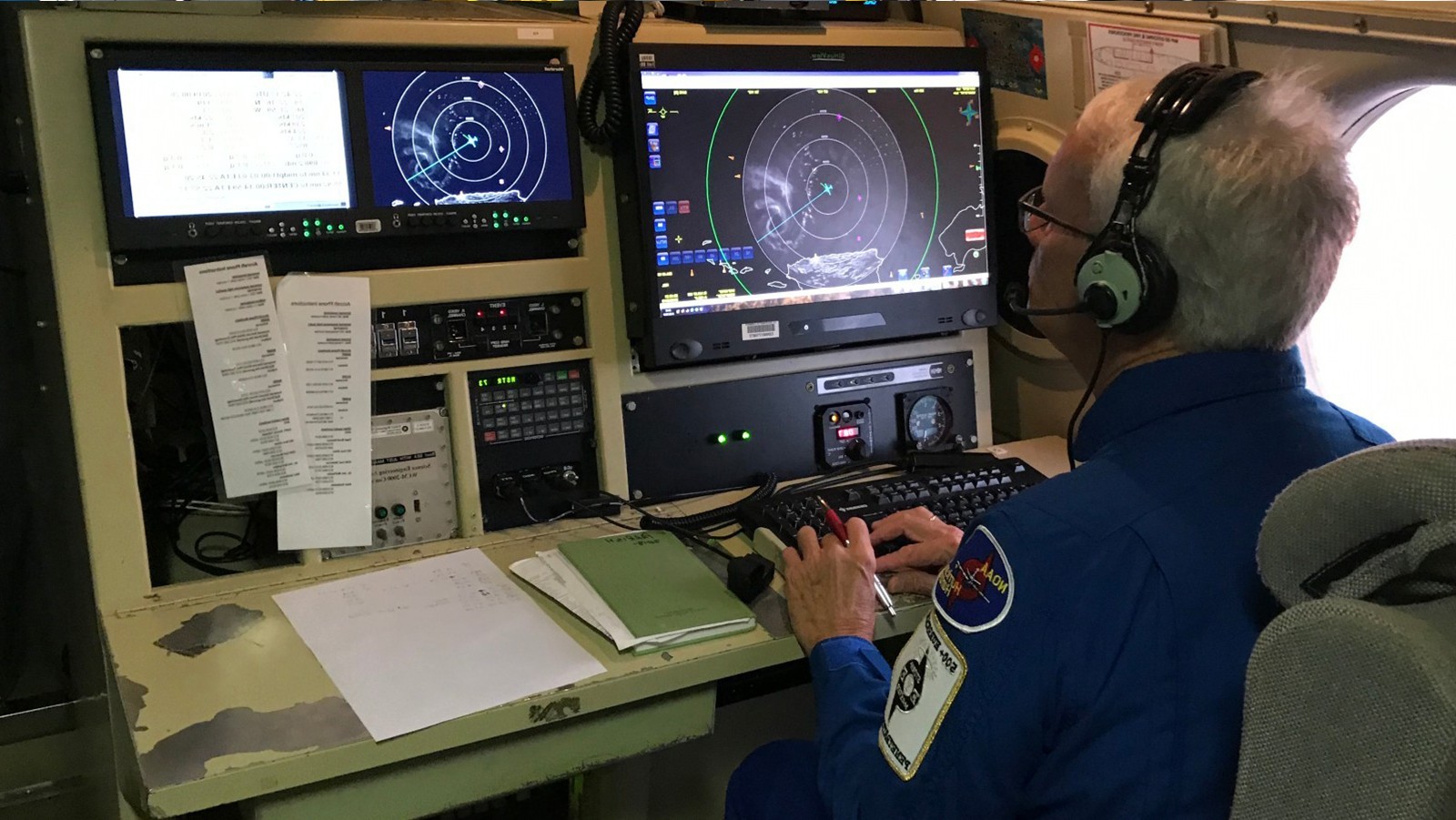
Abordar cuestiones de investigación sobre la dinámica y la física de los ciclones tropicales es un factor importante en la forma de tomar las observaciones en vuelo. Como tenemos una línea directa con las observaciones del Programa de Campo de Huracanes, podemos capitalizar el uso de estos datos para la investigación de vanguardia sobre la génesis y la intensificación de los huracanes.
Lea los planes de diseño experimental del Programa de Campo de Huracanes para saber más.
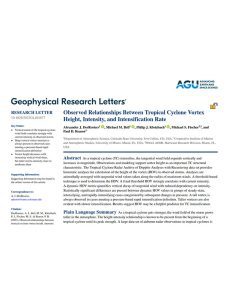
DesRosiers, A. J., Bell, M. M., Klotzbach, P. J., Fischer, M. S., & Reasor, P. D. (2023). Observed relationships between tropical cyclone vortex height, intensity, and intensification rate. Geophysical Research Letters, 50(8), e2022GL101877.
Resumen: A medida que un ciclón tropical (CT) se intensifica, el campo de viento tangencial se expande verticalmente y aumenta en magnitud. Las observaciones y los modelos apoyan la altura del vórtice como una característica estructural importante del CT. El conjunto de datos del Archivo de Radar de Ciclones Tropicales de Análisis Doppler con Recentrado proporciona análisis cinemáticos para el cálculo de la altura del vórtice (HOV) en tormentas observadas. Los análisis se promedian azimutalmente con valores de viento tangencial tomados a lo largo del radio de vientos máximos. Para determinar la HOV se utiliza una técnica basada en umbrales. Un umbral fijo HOV se correlaciona fuertemente con la intensidad actual. Una métrica HOV dinámica cuantifica el decaimiento vertical del viento tangencial con una dependencia reducida de la intensidad. Existen diferencias estadísticamente significativas entre los valores dinámicos del HOV en grupos de casos estacionarios, de intensificación y de rápida intensificación clasificados por los cambios posteriores de presión.
Relaciones observadas entre la altura del vórtice del ciclón tropical, la intensidad y la tasa de intensificación
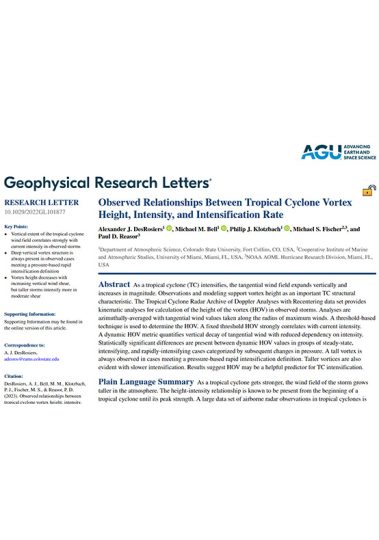
DesRosiers, A. J., Bell, M. M., Klotzbach, P. J., Fischer, M. S., & Reasor, P. D. (2023). Observed relationships between tropical cyclone vortex height, intensity, and intensification rate. Geophysical Research Letters, 50(8), e2022GL101877.
Resumen: A medida que un ciclón tropical (CT) se intensifica, el campo de viento tangencial se expande verticalmente y aumenta en magnitud. Las observaciones y los modelos apoyan la altura del vórtice como una característica estructural importante del CT. El conjunto de datos del Archivo de Radar de Ciclones Tropicales de Análisis Doppler con Recentrado proporciona análisis cinemáticos para el cálculo de la altura del vórtice (HOV) en tormentas observadas. Los análisis se promedian azimutalmente con valores de viento tangencial tomados a lo largo del radio de vientos máximos. Para determinar la HOV se utiliza una técnica basada en umbrales. Un umbral fijo HOV se correlaciona fuertemente con la intensidad actual. Una métrica HOV dinámica cuantifica el decaimiento vertical del viento tangencial con una dependencia reducida de la intensidad. Existen diferencias estadísticamente significativas entre los valores dinámicos del HOV en grupos de casos estacionarios, de intensificación y de rápida intensificación clasificados por los cambios posteriores de presión.
Publicaciones y referencias
2024
Alford, A.A., B. Schenkel, S. Hernandez, J.A. Zhang, M.I. Biggerstaff, E. Blumenauer, T.N. Sandmæl, and S.M. Waugh. Examining outer band supercell environments in landfalling tropical cyclones using ground-based radar analyses. Monthly Weather Review, 152(10):2265-2285, https://doi.org/10.1175/MWR-D-23-0287.1 2024 FY2025Chen, X., and F.D. Marks. Parameterizations of boundary layer mass fluxes in high-wind conditions for tropical cyclone simulations. Journal of the Atmospheric Sciences, 81(1):77-91, https://doi.org/10.1175/JAS-D-23-0086.1 2024 FY2024
Fischer, M.S., R.F. Rogers, P.D. Reasor, and J.P. Dunion. An observational analysis of the relationship between tropical cyclone vortex tilt, precipitation structure, and intensity change. Monthly Weather Review, 152(1):203-225, https://doi.org/10.1175/MWR-D-23-0089.1 2024 FY2024
Kang, S.K., E.J. Kim, S. Kim, J. Cione, D. Lee, S. Landwehr, H.-W. Kang, K.-O. Kim, C.S. Hong, M.H. Kwon, K.H. Oh, J.H. Lee, S. Noh, J.K. So, D.-J. Kang, D. Kim, J.-H. Park, S. Nam, Y.K. Cho, B. Ward, and I. Ginis. Anomalously large latent heat fluxes in low to moderate wind conditions within the eddy-rich zone of the northwestern Pacific. Frontiers in Marine Science, 11:1298641, https://doi.org/10.3389/fmars.2024.1298641 2024 FY2024
Kang, S.K., S.-H. Kim, I.-I. Lin, Y.-H. Park, Y. Choi, I. Ginis, J. Cione, J.Y. Shin, E.J. Kim, K.O. Kim, H.W. Kang, J.-H. Park, J.-R. Bidlot, and B. Ward. The North Equatorial Current and rapid intensification of super typhoons. Nature Communications, 15:1742, https://doi.org/10.1038/s41467-024-45685-2 2024 FY2024
Lin, G., Z. Wang, Y.F. Chu, C.L. Ziegler, X.M. Hu, M. Xue, B. Geerts, S. Paleri, A.R. Desai, K. Yang, M. Deng, and J. Degraw. Airborne measurements of scale-dependent latent heat flux impacted by water vapor and vertical velocity over heterogeneous land surfaces during the CHEESEHEAD19 campaign. Journal of Geophysical Research-Atmospheres, 129(3):e2023JD039586, https://doi.org/10.1029/2023JD039586 2024 FY2024
Murray, E.J., J. Dunion, K.B. Karnauskus, Z. Wang, and J.A. Zhang. Cloud height distributions and the role of vertical mixing in the tropical cyclone eye derived from compact Raman lidar observations. Geophysical Research Letters, 51(14):e2024GL108515, https://doi.org/10.1029/2024GL108515 2024 FY2024
Rios-Berrios, R., P.M. Finocchio, J.J. Alland, X. Chen, M.S. Fischer, S.N. Stevenson, and D. Tao. A review of the interactions between tropical cyclones and environmental vertical wind shear. Journal of the Atmospheric Sciences, 81(4):713-741, https://doi.org/10.1175/JAS-S-23-0022.1 2024 FY2024
Rojas, B.S., A.C. Didlake Jr., and J.A. Zhang. Asymmetries during eyewall replacement cycles of Hurricane Ivan (2004). Monthly Weather Review, 152(8):1741-1761, https://doi.org/10.1175/MWR-D-23-0129.1 2024 FY2024
Shimada, U., P.D. Reasor, R.F. Rogers, M.S. Fischer, F.D. Marks, J.A. Zawislak, And J.A Zhang. Shear-relative asymmetric kinematic characteristics of intensifying hurricanes as observed by airborne Doppler radar Monthly Weather Review, 152(2):491-512, https://doi.org/10.1175/MWR-D-22-0340.1 2024 FY2024
Tang, B.H., R. Rios-Berrios, and J.A. Zhang. Diagnosing radial ventilation in dropsonde observations of Hurricane Sam (2021). Monthly Weather Review, 152(8):1725-1739, https://doi.org/10.1175/MWR-D-23-0224.1 2024 FY2024
Wang, W., J. Han, J. Shin, X. Chen, A. Hazelton, L. Zhu, H.-S. Kim, X. Li, B. Liu, Q. Liu, J. Steffen, R. Sun, W. Zheng, Z. Zhang, and F. Yang. Physics schemes in the first version of NCEP operational Hurricane Analysis and Forecast System (HAFS). Frontiers in Earth Science, 12:1379069, https://doi.org/10.3389/feart.2024.1379069 2024 FY2024
Zhao, B., L. Wu, G. Wang, J.A. Zhang, L. Liu, C. Zhao, Z. Zhuang, C. Xia, Y. Xue, X. Li, and F. Quao. A numerical study of tropical cyclone and ocean responses to air-sea momentum flux at high winds. Journal of Geophysical Research-Oceans, 129(7):e2024JC020956, https://doi.org/10.1029/2024JC020956 2024 FY2024
2023
Chen, X., A. Hazelton, F.D. Marks, G.J. Alaka y C. Zhang. Performance of an improved TKE-based eddy-diffusivity mass-flux (EDMF) PBL scheme in 2021 hurricane forecasts from Hurricane Analysis and Forecast System. Meteorología y Predicción, 38(2):321-336, https://doi.org/10.1175/WAF-D-22-0140.1 2023 FY2023Chen, X., C.M. Rozoff, R.F. Rogers, K.L. Corbosiero, D. Tao, J.-F. Gu, F. Judt, E.A. Hendricks, Y. Wang, M.M. Bell, D.P. Stern, K.D. Musgrave, J.A. Knaff, and J. Kaplan. Research advances on internal processes affecting tropical cyclone intensity change from 2018–2022. Tropical Cyclone Research and Review, 12(1):10-29, https://doi.org/10.1016/j.tcrr.2023.05.001 2023 FY2023
DesRosiers, A.J., M.M. Bell, P.J. Klotzbach, M.S. Fischer, and P.D. Reasor. Observed relationships between tropical cyclone vortex height, intensity, and intensification rate. Geophysical Research Letters, 50(8):e2022GL101877, https://doi.org/10.1029/2022GL101877 2023 FY2023
Fischer, M.S., P.D. Reasor, B.H. Tang, K.L. Corbosiero, R.D. Torn, and X. Chen. A tale of two vortex evolutions: Using a high-resolution ensemble to assess the impacts of ventilation on a tropical cyclone rapid intensification event. Monthly Weather Review, 151(1):297-320, https://doi.org/10.1175/MWR-D-22-0037.1 2023 FY2023
Li, M., J.A. Zhang, L. Matak, and M. Momen. The impacts of adjusting momentum roughness length on strong and weak hurricane forecasts: A comprehensive analysis of weather simulations and observations. Monthly Weather Review, 150(5):1287-1302, https://doi.org/10.1175/MWR-D-22-0191.1 2023 FY2023
Li, Z., A. Tiwari, X. Sui, J. Garrison, F. Marks, and D. Niyogi. Studying brown ocean re-intensification of Hurricane Florence using CYGNSS and SMAP soil moisture data and a numerical weather model. Geophysical Research Letters, 50(19):e2023GL105102, https://doi.org/10.1029/2023GL105102 2023 FY2024
Ming, J., J.A. Zhang, X. Li, Z. Pu, and M. Momen. Observational estimates of turbulence parameters in the atmospheric surface layer of landfalling tropical cyclones. Journal of Geophysical Research-Atmospheres, 128(17):e2022JD037768, https://doi.org/10.1029/2022JD037768 2023 FY2023
Rajasree, P.M., X. Cao, H. Ramsay, K.M. Nunez-Ocasio, G. Kilroy, G.R. Alvey III, M. Chang, C.C. Nam, H. Fudeyasu, H.-F. Teng, and H. Yu. Tropical cyclogenesis: Controlling factors and physical mechanisms. Tropical Cyclone Research and Review, 12(3):165-181, https://doi.org/10.1016/j.tcrr.2023.09.004 2023 FY2023
Rogers, R.F., and J.A. Zhang. Airborne Doppler radar observations of tropical cyclone boundary layer kinematic structure and evolution during landfall. Geophysical Research Letters, 50(23):e2023GL105548, https://doi.org/10.1029/2023GL105548 2023 FY2024
Stone, Z., G.R. Alvey III, J.P. Dunion, M.S. Fischer, D.J. Raymond, R.F. Rogers, S. Sentic, and J. Zawislak. Thermodynamic contribution to vortex alignment and rapid intensification of Hurricane Sally (2020). Monthly Weather Review, 151(4):931-951, https://doi.org/10.1175/MWR-D-22-0201.1 2023 FY2023
Wadler, J.B., D.S. Nolan, J.A. Zhang, L.K. Shay, J.B. Olson, and J.J. Cione. The effect of advection on the three-dimensional distribution of turbulent kinetic energy and its generation in idealized tropical cyclone simulations. Journal of Advances in Modeling Earth Systems, 15(5):e2022MS003230, https://doi.org/10.1029/2022MS003230 2023 FY2023
Wadler, J.B., J.J. Cione, R.F. Rogers, and M.S. Fischer. On the distribution of convective and stratiform precipitation in tropical cyclones from airborne Doppler radar and its relationship to intensity change and environmental wind shear direction. Monthly Weather Review, 151(12):3209-3233, https://doi.org/10.1175/MWR-D-23-0048.1 2023 FY2024
Zhang, J.A., R.F. Rogers, P.D. Reasor, and J. Gamache. The mean kinematic structure of the tropical cyclone boundary layer and its relationship to intensity change. Monthly Weather Review, 151(1):63-84, https://doi.org/10.1175/MWR-D-21-0335 2023 FY2023
Zhang, X., S.D. Ditchek, K.L. Corbosiero, and W. Xu. Global and regional characteristics of radially outward propagating tropical cyclone diurnal pulses. Journal of Geophysical Research-Atmospheres, 128(7):e2022JD037660, https://doi.org/10.1029/2022JD037660 2023 FY2023
Zhu, P., J.A. Zhang, and F.D. Marks. On the lateral entrainment instability in the inner core region of tropical cyclones. Geophysical Research Letters, 50(8):e2022GL102494, https://doi.org/10.1029/2022GL102494 2023 FY2023
2022
Alvey, G.R., y A. Hazelton. ¿Cómo evolucionan los ciclones tropicales débiles y desalineados hacia la alineación? Un estudio de caso utilizando el Sistema de Análisis y Previsión de Huracanes. Journal of Geophysical Research-Atmospheres, 127(10):e2022JD037268, https://doi.org/10.1029/2022JD037268 2022 FY2023Alvey, G.R., M. Fischer, P. Reasor, J. Zawislak, and R. Rogers. Observed processes underlying the favorable vortex repositioning early in the development of Dorian (2019). Monthly Weather Review, 150(1):253-273, https://doi.org/10.1175/MWR-D-21-0069.1 2022 FY2022
Barron, N.R., A.C. Didlake, and P.D. Reasor. Statistical analysis of convective updrafts in tropical cyclone rainbands observed by airborne Doppler radar. Journal of Geophysical Research-Atmospheres, 127(6):e2021JD035718, https://doi.org/10.1029/2021JD035718 2022 FY2022
Chen, S., F. Qiao, J.A. Zhang, Y. Xue, H. Ma, and S. Chen. Observed drag coefficient asymmetry in a tropical cyclone. Journal of Geophysical Research-Oceans, 127(9):e2021JC018360, https://doi.org/10.1029/2021JC018360 2022 FY2022
Chen, X., G.H. Bryan, A. Hazelton, F.D. Marks, and P. Fitzpatrick. Evaluation and improvement of TKE-based eddy-diffusivity mass-flux (EDMF) planetary boundary layer scheme in hurricane conditions. Weather and Forecasting, 37(6):935-951, https://doi.org/10.1175/WAF-D-21-0168.1 2022 FY2022
Fischer, M.S., P.D. Reasor, R.F. Rogers, and J.F. Gamache. An analysis of tropical cyclone vortex and convective characteristics in relation to storm intensity using a novel airborne Doppler radar database. Monthly Weather Review, 150(9):2255-2278, https://doi.org/10.1175/MWR-D-21-0223.1 2022 FY2022
Foltz, G.R., C. Zhang, C. Meinig, J.A. Zhang, and D. Zhang. An unprecedented view inside a hurricane. EOS, 103(7):22-28, https://doi.org/10.1029/2022EO220228 2022 FY2022
Gramer, L.J., J.A. Zhang, G. Alaka, A. Hazelton, and S. Gopalakrishnan. Coastal downwelling intensifies landfalling hurricanes. Geophysical Research Letters, 49(13):e2021GL096630 , https://doi.org/10.1029/2021GL096630 2022 FY2022
Ming J., R. Liu, J.A. Zhang, and R.F. Rogers. The shear-relative variation of inflow angle and its relationship to tropical cyclone intensification. Journal of Geophysical Research-Atmospheres, 127(16):e2022JD037280, https://doi.org/10.1029/2022JD037280 2022 FY2022
Romdhani, O., J.A. Zhang, and M. Momen. Characterizing the impact of turbulence closures on real hurricane forecasts: A comprehensive joint assessment of grid resolution, turbulence models, and horizontal mixing length. Journal of Advances in Modeling Earth Systems, 14(9):e2021MS002796, https://doi.org/10.1029/2021MS002796 2022 FY2022
Wadler, J.B., J.J. Cione, J.A. Zhang, E.A. Kalina, and J. Kaplan. The effects of environmental wind shear direction on tropical cyclone boundary layer thermodynamics and intensity change from multiple observational datasets. Monthly Weather Review, 150(1):115-134, https://doi.org/10.1175/MWR-D-21-0022.1 2022 FY2022
Wu, Y.-C., M.-J. Yang, and R.F. Rogers. Examining terrain effects on the evolution of precipitation and vorticity of Typhoon Fanapi (2010) after departing the central mountain range on Taiwan. Monthly Weather Review, 150(6):1517-1540, https://doi.org/10.1175/MWR-D-21-0205.1 2022 FY2022
Zhao, B., G. Wang, J.A. Zhang, L. Liu, J. Liu, J. Xu, H. Yu, C. Zhao, X. Yu, C. Sun, and F. Qiao. The effects of ocean surface waves on tropical cyclone intensity: Numerical simulations using a regional atmosphere-ocean-wave coupled model. Journal of Geophysical Research-Oceans, 127(11):e2022JC019015, https://doi.org/10.1029/2022JC019015 2022 FY2023
Zhao, Z., R. Gao, J.A. Zhang, Y. Zhu, C. Liu, P.W. Chan, and Q. Wan. Observations of boundary layer wind and turbulence of a landfalling tropical cyclone. Nature Scientific Reports, 12:11056, https://doi.org/10.1038/s41598-022-14929-w 2022 FY2022
2021
Bucci, L.R., S.J. Majumdar, R. Atlas, G.D. Emmitt y S. Greco. Comprensión de la respuesta de la estructura de los ciclones tropicales a la asimilación de perfiles de viento sintéticos. Monthly Weather Review, 149(6):2031-2047, https://doi.org/10.1175/MWR-D-20-0153.1 2021 FY2021Chen, N., T. Tang, J.A. Zhang, L.-M. Ma, and H. Yu. On the distribution of helicity in the tropical cyclone boundary layer from dropsonde composites. Atmospheric Research, 249:105298, https://doi.org/10.1016/j.atmosres.2020.105298 2021 FY2021
Chen, X., J.-F. Gu, J.A. Zhang, F.D. Marks, R.F. Rogers, and J.J. Cione. Boundary layer recovery and precipitation symmetrization preceding rapid intensification of tropical cyclones under shear. Journal of the Atmospheric Sciences, 78(5):1523-1544, https://doi.org/10.1175/JAS-D-20-0252.1 2021
Chen, X., M. Xue, B. Zhou, J. Feng, J.A. Zhang, and F.D. Marks. Effect of scale-aware planetary boundary layer schemes on tropical cyclone intensification and structural changes in the gray zone. Monthly Weather Review, 149(7):2079-2095, https://doi.org/10.1175/MWR-D-20-0297.1 2021 FY2021
Gopalakrishnan, S., A. Hazelton, and J.A. Zhang. Improving hurricane boundary layer parameterization scheme based on observations. Earth and Space Science, 8(3):e2020EA001422 , https://doi.org/10.1029/2020EA001422 2021 FY2021
Green, A., S.G. Gopalakrishnan, G.J. Alaka, and S. Chiao. Understanding the role of mean and eddy momentum transport in the rapid intensification of Hurricane Irma (2017) and Hurricane Michael (2018). Atmosphere, 12(4):492, https://doi.org/10.3390/atmos12040492 2021 FY2021
Huang, J., Z. Zou, Q. Zeng, P. Li, J. Song, L. Wu, J.A. Zhang, S. Li, and P-W. Chan. The turbulent structure of the marine atmospheric boundary layer during and before a cold front. Journal of the Atmospheric Sciences, 78(3):863-875, https://doi.org/10.1175/JAS-D-19-0314.1 2021 FY2021
Lin, I.-I., R.F. Rogers, H.-C. Huang, Y.-C. Liao, D. Herndon, J.-Y. Yu, Y.-T. Chang, J.A. Zhang, C.M. Patricola, I.-F. Pun, and C.-C. Lien. A tale of two rapidly-intensifying supertyphoons: Hagibis (2019) and Haiyan (2013). Bulletin of the American Meteorological Society, 102(9):E1645-E1664, https://doi.org/10.1175/BAMS-D-20-0223.1 2021 FY2021
Rogers, R.F. Recent advances in our understanding of tropical cyclone intensity change processes from airborne observations. Atmosphere, 12(5):650, https://doi.org/10.3390/atmos12050650 2021 FY2021
Ryglicki, D.R., C.S. Velden, P.D. Reasor, D. Hodyss, and J.D. Doyle. Observations of atypical rapid intensification characteristics in Hurricane Dorian (2019). Monthly Weather Review, 149(7):2131-2150, https://doi.org/10.1175/MWR-D-20-0413.1 2021 FY2021
Tang, J., J.A. Zhang, P. Chan, K. Hon, X. Lei, and Y. Wang. A direct aircraft observation of helical rolls in the tropical cyclone boundary layer. Scientific Reports, 11:18771, https://doi.org/10.1038/s41598-021-97766-7 2021 FY2021
Wadler, J.B., J.A. Zhang, R.F. Rogers, B. Jaimes, and L.K. Shay. The rapid intensification of Hurricane Michael (2018): Storm structure and the relationship to environmental and air-sea interactions. Monthly Weather Review, 149(1):245-267, https://doi.org/10.1175/MWR-D-20-0145.1 2021 FY2021
Wang, X., H. Jiang, X. Li, and J.A. Zhang. Observed shear-relative rainfall asymmetries associated with landfalling tropical cyclones. Advances in Meteorology, 2021:4676713, https://doi.org/10.1155/2021/4676713 2021 FY2021
Zhang, G., X. Li, W. Perrie, and J.A. Zhang. Tropical cyclone winds and inflow angle asymmetry from SAR imagery. Geophysical Research Letters, 48(20):e2021GL095699, https://doi.org/10.1029/2021GL095699 2021 FY2022
Zhu, P., A. Hazelton, Z. Zhang, F. Marks, and V. Tallapragada. The role of eyewall turbulent transport in the pathway to intensification of tropical cyclones. Journal of Geophysical Research-Atmospheres, 126(17):e2021JD034983, https://doi.org/10.1029/2021JD034983 2021 FY2021
2020
Cione, J.J., G. Bryan, R. Dobosy, J. Zhang, G. de Boer, A.Aksoy, J. Wadler, E.Kalina, B. Dahl, K. Ryan, J. Neuhaus, E. Dumas, F. Marks, A. Farber, T. Hock y X. Chen 2020: El ojo de la tormenta: Observación de huracanes con un pequeño sistema de aviones no tripulados. Bull. Amer. Meteor. Soc. https://doi.org/10.1175/BAMS-D-19-0169.1 Fischer, M. S., R. F. Rogers, y P. D. Reasor, 2020: Los ciclos de intensificación rápida y sustitución de la pared ocular del huracán Irma (2017). Mon. Wea. Rev., 148, 981–1004, https://doi.org/10.
1175/MWR-D-19-0185.1. Rogers, R. F., P. D. Reasor, J. A. Zawislak, y L. T. Nguyen, 2020: Precipitation Processes and Vortex Alignment during the Intensification of a Weak Tropical Cyclone in Moderate Vertical Shear. Mon. Wea. Rev., 148, 1899–1929, https://doi.org/10.1175/MWR-D-19-0315.1. 2019
Ahern, K., M.A. Bourassa, R.E. Hart, J.A. Zhang, y R.F. Rogers, 2019: Observed Kinematic and Thermodynamic Structure in the Hurricane Boundary Layer during Intensity Change. Mon. Wea. Rev., 147, 2765–2785, https://doi.org/10.1175/MWR-D-18-0380.1.Alvey III, G. R., E. Zipser, J. Zawislak, 2019: ¿Cómo evoluciona el huracán Edouard (2014) hacia la simetría antes de la intensificación? Un estudio de conjunto de alta resolución. J. Atmos. Sci., en prensa.
Chen, X., J. A. Zhang, y F. D. Marks, 2019: A thermodynamic pathway leading to rapid intensification of tropical cyclones in shear. Geophys. Res. Lett., 46, 9241-9251, https://doi.org/10.1029/2019GL083667
Chen X., J. A. Zhang, F. D. Marks, R. F. Rogers, y J. J. Cione, 2019: Precipitation Symmetrization and Rapid Intensification of Tropical Cyclones under Shear: J. Atmos. Sci., en revisión.
Dunion, J.P., C.D. Thorncroft, y D.S. Nolan. 2019: Señales del ciclo diurno de los ciclones tropicales en una corrida natural de huracanes. Mon. Wea. Rev., 147, 363-388, https://doi.org/10.1175/MWR-D-18-0130.1.
Guimond, S.R., P.D. Reasor, G.M. Heymsfield, y M. McLinden, 2019: The Dynamics of Vortex Rossby Waves and Secondary Eyewall Development in Hurricane Matthew (2016): New Insights from Radar Measurements. J. Atmos. Sci., en revisión.
Martínez, J., M.M. Bell, R.F. Rogers, y J.D. Doyle, 2019: Axisymmetric potential vorticity evolution of Hurricane Patricia (2015), J. Atmos. Sci., 76, 2043-2063, https://doi.org/10.1175/JAS-D-18-0373.1.
Molinari, J., J.A. Zhang, R.F. Rogers, y D. Vollaro, 2019: Repeated Eyewall Replacement Cycles in Hurricane Frances (2004). Mon. Wea. Rev., 0, https://doi.org/10.1175/MWR-D-18-0345.1.
Nguyen, L.T., R.F. Rogers, J. Zawislak, y J.A. Zhang, 2019: Assessing the Influence of Convective Downdrafts and Surface Enthalpy Fluxes on Tropical Cyclone Intensity Change in Moderate Vertical Wind Shear. Mon. Wea. Rev., 0, https://doi.org/10.1175/MWR-D-18-0461.1.
Wadler, J., R.F. Rogers, y P.D. Reasor, 2018a: The relationship between spatial variations in the structure of convective bursts and tropical cyclone intensification as determined by airborne Doppler radar. Mon. Wea. Rev., 146, 761-780. https://doi.org/10.1175/MWR-D-17-0213.1.
Zhang, J.A. y R.F. Rogers, 2019: Effects of parameterized boundary layer structure on hurricane rapid intensification in shear. Mon. Wea. Rev., 147, 853-871, https://doi.org/10.1175/MWR-D-18-0010.1.
2018
Bowers, G. S., Smith, D. M., Kelley, N. A., Martinez-McKinney, G. F., Cummer, S. A., Dwyer, J. R., et al. ( 2018). Un destello de rayos gamma terrestre dentro de la pared del ojo del huracán Patricia. Revista de Investigación Geofísica: Atmospheres, 123, 4977– 4987. https://doi.org/10.1029/2017JD027771Didlake, A.C., Paul D. Reasor, y R.F. Rogers, W.-C. Lee, 2018: Dinámica de la transición de las bandas de lluvia en espiral a un eyewall secundario en el huracán Earl (2010). J. Atmos. Sci., 75, 2909-2929, https://doi.org/10.1175/JAS-D-17-0348.1.
Dougherty, E.M., J. Molinari, R.F. Rogers, J.A. Zhang y J.P. Kossin, 2018: Huracán Bonnie (1998): El mantenimiento de la intensidad durante la alta cizalladura vertical del viento y un ciclo de reemplazo de la pared ocular. Mon. Wea. Rev., 146, 3383-3399, https://doi.org/10.1175/MWR-D-18-0030.1
Guimond, S. R. J. A. Zhang, J. Sapp, y S. J. Frasier, 2018: Turbulencia coherente en la capa límite del huracán Rita (2005) durante un ciclo de reemplazo del eyewall. J. Atmos. Sci. 75, 3071-3093.
Leighton, H., S. Gopalakrishnan, J.A. Zhang, R.F. Rogers, Z. Zhang, y V. Tallapragada, 2018: Distribución azimutal de la convección profunda, factores ambientales y la rápida intensificación de los ciclones tropicales: Una perspectiva de las previsiones del conjunto HWRF del huracán Edouard (2014). J. Atmos. Sci., 75, 275-295, https://doi.org/10.1175/JAS-D-17-0171.1
Wadler, J.B., J.A. Zhang, B. Jaimes, y L.K. Shay, 2018b: Downdrafts and the Evolution of Boundary Layer Thermodynamics in Hurricane Earl (2010) before and during Rapid Intensification. Mon. Wea. Rev., 146, 3545-3565.
2017
Didlake, A.C., G.M. Heymsfield, P.D. Reasor, y S.R. Guimond, 2017: Concentric Eyewall Asymmetries in Hurricane Gonzalo (2014) Observed by Airborne Radar. Mon. Wea. Rev., 145, 729–749, https://doi.org/10.1175/MWR-D-16-0175.1Hazelton, A.T., R.F. Rogers, y R.E. Hart, 2017: Análisis de las ráfagas convectivas simuladas en dos huracanes del Atlántico. Parte I: Formación y desarrollo de estallidos convectivos. Mon. Wea. Rev., 145(8), 3073-3094, doi: 10.1175/MWR-D-16-0267.1.
Hazelton, A.T., R.E. Hart, y R.F. Rogers, 2017: Analizando los estallidos convectivos simulados en dos huracanes del Atlántico. Parte II: Cambio de intensidad debido a los estallidos convectivos. Mon. Wea. Rev., 145(8), 3095-3117, doi: 10.1175/MWR-D-16-0268.1.
Kalina, E.A., S. Matrosov, J. Cione, F. Marks, J. Vivekanandan, R. Black, J. Hubbert, M. Bell, D. Kingsmill y A. White 2017: Las trayectorias del agua helada de las especies de hielo pequeñas y grandes en los huracanes Arthur (2014) e Irene (2011). J. Appl. Meteorol. DOI: http://dx.doi.org/10.1175/JAMC-D-16-0300.1
Martínez, J., M.M. Bell, J.L. Vigh, y R.F. Rogers, 2017: Examinando la estructura e intensificación de los ciclones tropicales con el conjunto de datos FLIGHT+ de 1999 a 2012. Mon. Wea. Rev., 145, 4401-4421, https://doi.org/10.1175/MWR-D-17-0011.1.
Nguyen, L.T., R.F. Rogers, y P.D. Reasor, 2017: Influencias termodinámicas y cinemáticas en la simetría de la precipitación en los ciclones tropicales cizallados: Bertha y Cristóbal (2014). Mon. Wea. Rev., 145, 4423-4446, https://doi.org/10.1175/MWR-D-17-0073.1.
Smith, R. K., J. A. Zhang y M. T. Montgomery, 2017: La dinámica de la intensificación en una simulación de previsión meteorológica e investigación del huracán Earl (2010). Q. J. R. Meteorol. Soc., 143, 297-308.
Zhang, J.A., R.F. Rogers, y V. Tallapragada, 2017: Impact of Parameterized Boundary Layer Structure on Tropical Cyclone Rapid Intensification Forecasts in HWRF. Mon. Wea. Rev., 145, 1413-1426, doi: 10.1175/MWR-D-16-0129.1.
2016
Abarca, S.F., M.T. Montgomery, S.A. Braun, y J.P. Dunion, 2016: Sobre la formación de la pared ocular secundaria del huracán Edouard (2016), Mon. Wea. Rev. 144, 3321-3331, https://doi.org/10.1175/MWR-D-15-0421.1.Guimond, S.R., G.M. Heymsfield, P.D. Reasor, y A.C. Didlake, 2016: La rápida intensificación del huracán Karl (2010): Nuevas observaciones por teledetección de estallidos convectivos desde la plataforma Global Hawk. J. Atmos. Sci., 73, 3617-3639, https://doi.org/10.1175/JAS-D-16-0026.1
Rogers, R.F., J.A. Zhang, J. Zawislak, H. Jiang, G.R. Alvey III, E.J. Zipser, y S.N. Stevenson, 2016: Observaciones de la estructura y evolución del huracán Edouard (2014) durante el cambio de intensidad. Parte II: Estructura cinemática y la distribución de la convección profunda. Mon. Wea. Rev., 144, 3355-3376.
Zawislak, J., H. Jiang, G.R. Alvey III, E.J. Zipser, R.F. Rogers, J.A. Zhang y S.N. Stevenson, 2016: Observaciones de la estructura y evolución del huracán Edouard (2014) durante el cambio de intensidad. Parte I: Relación entre la estructura termodinámica y la precipitación. Mon. Wea. Rev., 144, 3333-3354.
2015
Cione, J.J. 2015: El papel relativo del océano y la atmósfera según las observaciones aire-mar en los huracanes. Mon. Wea. Rev. doi: 10.1175/MWR-D-13-00380.1Hazelton, A., R.F. Rogers, y R.Hart, 2015: Shear-Relative Asymmetries in Tropical Cyclone Eyewall Slope. Mon. Wea. Rev., 143, 883-903.
Reasor, P.D. y M.T. Montgomery, 2015: Evaluation of a Heuristic Model for Tropical Cyclone Resilience. J. Atmos. Sci., 72, 1765-1782, https://doi.org/10.1175/JAS-D-14-0318.1
Rogers, R.F., P.D. Reasor, y J.A. Zhang, 2015: Estructura multiescala y evolución del huracán Earl (2010) durante su rápida intensificación. Mon. Wea. Rev., 143, 536-562.
Susca-Lopata, G., J. Zawislak, E.J. Zipser, y R.F. Rogers, 2015: El papel de las condiciones ambientales observadas y la evolución de las precipitaciones en la rápida intensificación del huracán Earl (2010). Mon. Wea. Rev., 143, 2207-2223.
Zhang, J. A., y F. D. Marks, 2015: Efectos de la difusión horizontal en el cambio de intensidad y estructura de los ciclones tropicales en simulaciones numéricas tridimensionales idealizadas, Mon. Wea. Rev., 143, 10: 3981-3995.
Zhang, J. A., D. S. Nolan, R. F. Rogers, y V. Tallapragada, 2015: Evaluando el impacto de las mejoras en la parametrización de la capa límite en las previsiones de intensidad y estructura de los huracanes en HWRF, Mon. Wea. Rev., 143, 3136-3155
2014
Dunion, J.P., C.D. Thorncroft, y C.S. Velden, 2014: El ciclo diurno del ciclón tropical de los huracanes maduros. Mon. Wea. Rev., 142, 3900-3919, https://doi.org/10.1175/MWR-D-13-00191.1.
¿Buscando literatura? Busque en nuestra base de datos de publicaciones.