Hurricane Field Program
2026 Season
The 2026 Hurricane Field Program supports NOAA’s Advancing the Prediction of Hurricanes Experiment (APHEX). This page is organized by projects that support research into the lifecycle stages of storms, from genesis to end stage, as well as ocean observations and satellite validation.
About APHEX: Developed in partnership with NOAA’s Environmental Modeling Center, National Hurricane Center, Aircraft Operations Center, and AOML’s Physical Oceanography Division, APHEX is intended to improve our understanding and prediction of hurricane track, intensity, structure, and associated hazards by collecting observations that will aid in the improvement of current operational hurricane models, such as the Hurricane Analysis and Forecast System (HAFS) model, and the development of the next-generation operational hurricane models.
See How the Hurricane Field Program Supports NOAA Operations.
This document outlines the support HRD provides for operationally-tasked (EMC/NHC) NOAA hurricane aircraft missions. In the event of an operationally-tasked mission, HRD will provide support to ensure the mission achieves its goals. Click on the link below to read full documentation.
Experiments and Modules
Genesis Stage
Favorable Air Mass (FAM)
Investigators
Primary Investigator: Ghassan Alaka,
Jason Dunion, Trey Alvey, Sharan Majumdar (Univ. of Miami/RSMAES), Alan Brammer (CSU/CIRA), Philippe Papin (NHC), Quinton Lawton(NCAR), Gabe Larouche (Univ. of Miami/RSMAES)
Science Description
Although the ingredients for tropical cyclone formation have been well-documented for decades, it is still difficult to predict which disturbances will develop and which ones will not. A big factor in this uncertainty is the favorability of the air mass ahead of, and interacting with, the disturbance. This experiment proposes to collect
observations of mid-level humidity and winds to assess the favorability of the disturbance’s environment for tropical cyclogenesis.
Full Documentation
Download PDFs:
Precipitation during Formation and Observing its Response across Multiple Scales (PREFORM)
Investigators
Primary Investigator: Ethan Murray, Jason Dunion, Jun Zhang, Ghassan Alaka, and George Alvey
Science Description
Accurately predicting when a tropical cyclone (TC) will develop from a pre-tropical depression disturbance (pre-TD) remains a significant challenge for forecasters. This difficulty arises because multiple atmospheric processes, such as stratiform rainfall, deep convection, dry air entrainment, and convectively generated cold pools, interact in complex, multiscale ways within pre-TDs. This module will leverage NOAA P-3 and G-IV aircraft observations to investigate how these processes interact and ultimately determine whether or not a disturbance develops into a TC.
Full Documentation
Download PDFs:
Early Stage
Stratiform Spiral Module (SSM)
Investigators
Primary Investigator: Xuejin Zhang
Trey Alvey, Michael Bell (CSU), Joe Cione (AOML/HRD), Jim Doyle (NRL), Greg McFarquhar (OU), Chelsea Nam (FSU), Josh Wadler (ERAU), and Jun Zhang (UM/CIMAS & AOML/HRD)
Science Description
This module samples the distribution of cloud and rain droplets and ice and snow particles and how those distributions vary with altitude across the freezing level in broad regions of relatively weak precipitation and upward motion.
Full Documentation
Download PDFs:
Vortex Alignment Module (VAM)
Investigators
Primary Investigators: Michael Fischer, George Alvey
Paul Reasor, Jason Dunion, Ethan Murray, Robert Rogers (AP-TCRC), David Nolan (Univ. of Miami), Daniel Stern (NRL), Zeljka Stone (New Mexico Tech Univ.), David Raymond (New Mexico Tech Univ.), Stipo Sentic (New Mexico Tech Univ.), David Schecter (NorthWest Research Associates), Xiaomin Chen (University of Alabama in Huntsville), and Rosimar Rios-Berrios (National Center for Atmospheric Research)
Science Description
In early-stage tropical cyclones (TCs), the rate at which a TC intensifies is strongly related to the vertical alignment of a storm’s circulation. However, the physical processes responsible for changes in the alignment of a TC circulation are not well understood. This module aims to improve our understanding of the alignment process through the collection of relatively-high frequency observations of the three-dimensional TC structure.
Full Documentation
Download PDFs:
Multi-Lidar Analysis of Boundary Layer and Cloud Structure
Investigators
Primary Investigators: Jun Zhang (PI),
Zhien Wang (co-PI; Stony Brook University), Ethan Murray
(co-PI), Jason Dunion (co-PI), Joseph Cione, Joshua Wadler (ERAU), Lev Looney, Gregory Foltz, Sim Aberson, Ping Zhu (FIU)
Science Description
This experiment will measure the lowest part of tropical cyclones, where the ocean fuels the storm. Using advanced airborne lidar together with standard aircraft observations, we will measure wind, moisture, and cloud structure at high resolution. These data will improve understanding of how storms intensify and help improve hurricane forecasts, especially when intensity change is difficult to predict.
Full Documentation
Download PDFs:
G-IV Over Storm
Investigators
Primary Investigators: Jason Sippel, Lisa Bucci (NHC), Heather Holbach, Sarah Ditchek, Kelly Ryan,
Alan Brammer, Jason Dunion, Dan Brown (NHC), Eric Blake (NHC)
Science Description
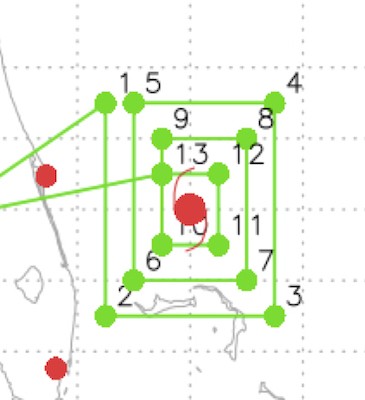
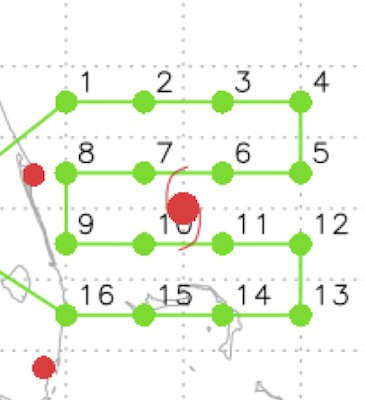
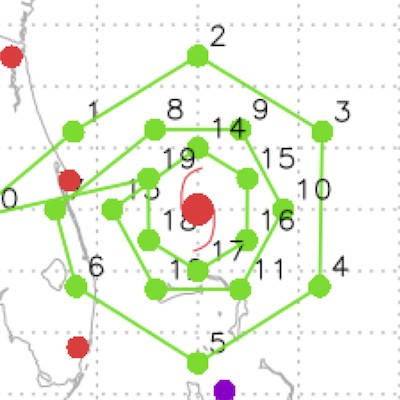
The experiment aims to gather over-TC data with the G-IV. Historically, the G-IV has been used to gather data on the periphery of TCs, but recent work suggests that bringing the G-IV pattern radially inward and over the TC vortex would improve its impacts on forecasts.
Full Documentation
Download PDFs:
Tropical Transition
Investigators
Primary Investigator: Kelly Ryan, Michael Folmer (NOAA/OPC), Philippe Papin (NOAA/NHC),
John Cangialosi (NOAA/NHC), John L. Beven (NOAA/NHC), and Jeff Halverson (University
of Maryland Baltimore County)
Science Description
The Tropical Transition Experiment focuses on obtaining key measurements during the transition of non-tropical systems into tropical cyclones. This specific TC genesis process is of particular interest to the National Hurricane Center (NHC) and Ocean Prediction Center (OPC) because it tends to introduce uncertainty in cyclone characterization, which impacts operational responsibilities for watches and warnings. The data collected during this experiment aims to refine the criteria used for NHC and OPC decision making and will contribute to an understudied aspect of TC development.
Full Documentation
Download PDFs:
Mature Stage
Distribution of Hazardous Winds
Investigators
Primary Investigators: Kelly Ryan, Heather Holbach, Lisa Bucci (NOAA/NHC), and Philippe Papin (NOAA/NHC)
Science Description
Estimating tropical cyclone wind hazards can be difficult and operationally often requires assumptions to be made about surface wind characteristics relative to available flight-level observations. Approximations of surface wind using reconnaissance flight level (700 mb or 850 mb) have been routinely supported by symmetric assumptions, but observational and modeling comparisons suggest departures from this framework, occasionally detecting variations in surface winds both radially (distance from center) and azimuthally (around the storm). Data collected will be used to refine assumptions asymmetrically, estimate the uncertainty in quadrant wind radii, investigate asymmetries in the boundary layer as they relate to wind and wave hazards, and expose potential boundary layer biases in numerical weather and climate models.
Full Documentation
Download PDFs:
Eye-Eyewall Mixing
Investigators
Primary Investigators: Sim Aberson
Joe Cione, Jun Zhang
Science Description
Small features in the eyes and eyewalls of very intense tropical cyclones have been hypothesized to increase the amount of energy available for hurricane intensification, or to be responsible for damaging surface wind at landfall or intense turbulence features impacting flight operations. However, the structures of these features, especially the temperature and humidity structures, have never been documented.
Full Documentation
Download PDFs:
Gravity Wave
Investigators
Primary Investigators: Jun Zhang (PI) and David Nolan (co-PI, UM)
Science Description
Tropical cyclone (TC) convection produces gravity waves that propagate both upward and outward. The observational data collected from this module will be analyzed to quantify the characteristics of the gravity waves in mature-stage hurricanes and their relationship with storm intensity and intensity change. These data would also provide valuable information for model evaluation and physics improvement.
Full Documentation
Download PDFs:
Ocean Winds
Investigators
Primary Investigators: Paul Chang (PI, NOAA/NESDIS/STAR),
Zorana Jelenak (UCAR, NOAA/NESDIS/STAR), Joe Sapp (Global Science & Technology, Inc., NOAA/NESDIS/STAR), and Suleiman Alsweiss (Global Science & Technology, Inc., NOAA/NESDIS/STAR); Heather Holbach (HRD PI)
Science Description
To improve our understanding of microwave retrievals of the ocean surface and atmospheric wind fields, and to evaluate new remote sensing techniques/technologies. To help validate satellite-based sensors of the ocean surface in extreme conditions and reduce risk for future satellite missions. To provide forecasters with near-real-time hurricane boundary layer profiles, where possible.
Full Documentation
Download PDFs:
Strategic use of Emerging Technologies To Advance Hurricane Forecasting
Investigators
Primary Investigators: Joseph Cione, Josh Wadler (ERAU), Jun Zhang, Annette Hollingshead
Co-Investigator(s): Jack Elston (BST), Sean Culbertson (Dragoon), Ray Chan (StratoSolutions), Petteri Survo (Skyfora), Mark DeMaria (CSU), Zhan Zhang (EMC), David Richter (Notre Dame), Michael Bell (CSU), Sim Abserson, Kathryn Sellwood, Lev Looney, Xuejin Zhang, Altug Aksoy, Frank Marks, Kelly Ryan, Brittany Dahl, Ron Dobosy (NOAA/ARL-ret), Don Lenschow (NCAR), Josh Alland (NCAR), Rosimar Rios- Berrios (NCAR), Chris Rozoff (NCAR), Eric Hendricks (NCAR), Falko Judt (NCAR), Jonathan Vigh (NCAR), Xiaomin Chen (UAH), Johna Rudzin-Schwing (MS State), Zhien Wang (SBU), George Bryan (PennState)
Science Description
This experiment will leverage NOAA’s P-3 aircraft to deploy uncrewed assets into regions of the TC environment that are unsafe for crewed operations. The experimental goals are to collect detailed observations that will improve the physical understanding of hurricane structures, enhance real-time situational awareness, and, ultimately, lead to better operational forecasts of TC track and intensity. It is believed that observations from these unique platforms will improve basic understanding and enhance forecaster situational awareness. Detailed analyses of data collected from these small drones also have the potential to improve the physics of computer models that predict changes in storm intensity.
Full Documentation
Download PDFs:
Tail Doppler Radar Analysis Evaluation
Investigators
Primary Investigators: Paul Reasor
Science Description
Three-dimensional wind analyses derived from two P-3 aircraft equipped with tail-Doppler radar (TDR) and flying simultaneous, perpendicular transects through the hurricane eyewall are compared in an evaluation of the Doppler-radar wind analysis method. Through this evaluation, we seek to gain a better understanding of how to relate radar-derived peak wind speed and other aspects of hurricane wind structure to similar estimates using conventional observations.
Full Documentation
Download PDFs:
Ventilation and Dry-Air Entrainment Module
Investigators
Primary Investigators: Brian Tang (UAlbany) and Trey Alvey
Science Description
Ventilation occurs when drier and/or cooler environmental air intrudes into a vertically-sheared, tilted tropical cyclone (TC). Ventilation pathways include lateral intrusion (radial ventilation) and downward intrusion (downdraft ventilation) of dry and/or cool air. Both pathways may inhibit intensification. This module aims to collect observational data to study ventilation pathways, validate model simulations of ventilation in TCs, and assess the link between ventilation and intensity changes.
Full Documentation
Download PDFs:
Tropical Cyclone Diurnal Cycle Module
Investigators
Primary Investigators: Jason Dunion (PI),
Jun Zhang (Co-PI), Ethan Murray (Co-PI), and James Ruppert (University of Oklahoma)
Science Description
This module aims to collect observations that improve the understanding of a phenomenon called the tropical cyclone (TC) diurnal cycle where the cloud fields of TCs expand and contract each day. The daily expansions are associated with a pulse of thunderstorms and rain that travel hundreds of kilometers away from the TC center and impact the flow in the storm environment as they progress outward.
Full Documentation
Download PDFs:
End Stage
Tropical Cyclones at Landfall
Investigators
Primary Investigators: Heather Holbach,
John Kaplan, Jun Zhang, Ghassan Alaka, Lew Gramer, Lev Looney, George (Trey) Alvey, Brian Phillips (University of Florida), Michael Biggerstaff (University of Oklahoma), David Nolan (University of Miami), Xiaomin Chen (University of Alabama in Huntsville), Johna Rudzin (Mississippi State University), John Schroeder (Texas Tech University), Ben Schenkel (OU/CIWRO, NOAA/OAR/NSSL), Addison Alford (NOAA/OAR/NSSL)
Science Description
Landfalling tropical cyclones (TCs) often produce a variety of high impact weather over land including tornadoes and damaging winds (particularly gusts) for which there exists limited objective forecast guidance. Thus, our experiment seeks to utilize P-3 aircraft, land-based mobile research team instrumentation, and ocean-based uncrewed surface vehicles to collect data in landfalling TCs to improve both our understanding and capability to predict the dangerous phenomena often associated with these landfalling systems.
Full Documentation
Download PDFs:
Extratropical Transition
Investigators
Primary Investigator: Sim Aberson
Science Description
Tropical cyclones can either decay (spin down) or transform into powerful extratropical cyclones when they encounter cold water below or high wind shear in the atmosphere. The mechanisms by which tropical cyclones become extratropical is not well forecast by numerical models leading to large errors, especially in impacts downstream of the actual transitioning cyclone. This experiment aims to improve forecasts of these systems.
Full Documentation
Download PDFs:
Ocean Observing
CHAOS: Coordinated Hurricane Atmosphere-Ocean Sampling
Investigators
Primary Investigators: Lev Looney (NOAA/AOML & UMiami/CIMAS), Cheyenne Stienbarger (NOAA/GOMO), Jun Zhang (NOAA/AOML & UMiami/CIMAS), Heather Holbach (NOAA/AOML & FSU/NGI)
Maria Aristizabal Vargas (Lynker at NOAA/NCEP/EMC), Michael Bell (CSU), Luca Centurioni (SIO), Paul Chang (NOAA/NESDIS/STAR), Joseph Cione (NOAA/AOML), Gregory Foltz (NOAA/AOML), Stephen Howden (USM), Zorana Jelenak (UCAR), Hyun-Sook Kim (NOAA/AOML), Matthieu Le Henaff (NOAA/AOML), Guo Lin (NOAA/AOML & UMiami/CIMAS), Kevin Martin (USM), Edoardo Mazza (CICOES/ U. Washington), Travis Miles (Rutgers University), Theresa Paluszkiewicz (OOC, LLC), David Richter (U. Notre Dame), Johna Rudzin (Mississippi State), Joe Sapp (NOAA/NESDIS), Martha Schönau (SIO), Jim Thomson (APL, U. Washington), Joshua Wadler (Embry-Riddle Aeronautical University), Dongxiao Zhang (CICOES/U. Washington & NOAA/PMEL)
Science Description
CHAOS presents a coordinated multi-platform, multi-institutional approach utilizing a diverse suite of innovative observing platforms (i.e., autonomous, uncrewed, expendable) and conventional ones (e.g., aircraft) focused on:
● Targeted coordinated observations of the air-sea transition zone, including the open ocean and coastal regions, to improve the understanding of air-sea interactions before, during, and after tropical cyclone (TC) passage for improved prediction and modeling
● Coordinated atmospheric and oceanic observations with sustained monitoring of key ocean features – e.g., major ocean currents, oceanic eddies and rings, and freshwater barrier layers.
Full Documentation
Download PDFs:
Ocean Survey
Investigators
Primary Investigators: Jun Zhang (PI, HRD/CIMAS), Nick Shay (Co-PI, UM), Jason Sippel (Co-PI),
Benjamin Jaimes (UM), Elizabeth Sanabia (UW), Sue Chen (NRL), Joseph Cione (AOML), Cheyenne Stienbarger (GOMO), Lev Looney (CIMAS), David Richter (UND), Michael Bell (CSU), Steven Jayne (WHOI), Joshua Wadler (ERAU), James Doyle (NRL), Gregory Foltz (AOML), Xuejin Zhang (AOML), Heather Holbach (FSU/NGI), Martha Schonau (Scripps), Luca Centurioni (Scripps), Theresa Paluszkiewicz (OOC, LLC), Bia Villas Bôas (MINES), Henry Potter (TAMU), Paul Chang (NESDIS)
Science Description
Physical representation of how the atmosphere and ocean interact in numerical forecast models of tropical cyclones (TCs) have not been fully evaluated against observations. Near collocated and simultaneous measurements of the ocean and the atmosphere just above the ocean surface, the energy exchanges that occur between them, and how they change over time have been less understood due to lack of substantial close coordination across a wide array of ocean and atmosphere observing platforms. This experiment will provide a unique opportunity to evaluate how well coupled forecast models represent these lowest regions of storms. The new type of observations that are collected should help improve the model initialization and inform how coupled forecast models represent interactions between the ocean and atmosphere in hurricanes.
Full Documentation
Download PDFs:
SASCWATCH: Study on Air-Sea Coupling with Waves, Turbulence, & Clouds at High winds
Investigators
Primary Investigators: David Richter (PI, University of Notre Dame), Michael Bell (Co-PI, Colorado State University), Jason Dunion (Co-PI), Jun Zhang (Co-PI)
Bia Villas Bôas (Colorado School of Mines), Elizabeth Sanabia (University of Washington, Applied Physics Laboratory), Steven Jayne (Woods Hole Oceanographic Institution), Henry Potter (Texas A&M University), Johna Rudzin (Mississippi State University)
Science Description
The exchange of momentum, heat, and moisture between the ocean and atmosphere plays a central role in the presence, timing, location, and severity of extreme weather events including tropical cyclones (TCs). The experiment aims to improve our understanding and parameterization of air-sea interaction by focusing on two central elements: waves and turbulence in the TC environment. This experiment uses state-of-the art measurement and modeling platforms, while at the same time unlocking the potential of existing databases through progress in theoretical understanding. The observational work centers on co-located measurements of ocean, wave, and turbulence properties simultaneously.
Full Documentation
Download PDFs:
Satellite Validation
Synthetic Aperture Radar Wind Inspection with NOAA P-3 Data (SARWIND)
Investigators
Primary Investigators: Philippe Papin, Jason Dunion
Lisa Bucci, Eric Blake, Brad Reinhart (NHC/NWS/NOAA), Jim Doyle (NRL), Victoria Pizzini (University of Miami), Christopher Jackson, Tyler Ruff (NOAA-STAR), Eric Arsenault (Canadian Space Agency), Alexis Mouche (Ifremer)
Science Description
This experiment seeks to use aircraft observations to better validate high-resolution surface wind speed measurements becoming more frequently available with Synthetic Aperture Radar (SAR) polar orbiting passes. This will be accomplished by coordinating NOAA P-3 flights to occur simultaneously with an orbiting SAR pass near a TC or other ocean environments deemed research relevant to sample the wind and wave interface near the surface.
Full Documentation
Download PDFs:
Operational Flight Maps

The P-3 Aircraft Operational Flight Map
Primary Atlantic operating bases and ranges (assuming ~2-h on-station time) for the P-3.

The G-IV Aircraft Operational Flight Map
Primary Atlantic operating bases and ranges (assuming ~2-h on-station time) for the G-IV.