Staff Directory

How does El Niño Impact Atlantic Hurricane Season
NOAA has released their seasonal outlook for the 2026 hurricane season – spanning from June 1st to November 30th – reporting a 55% probability of a below average season. This prediction is primarily driven by several factors including a strong El Niño event expected to emerge in the Pacific basin. This phenomenon will disrupt typical […]
New drone data improves hurricane intensity forecasts
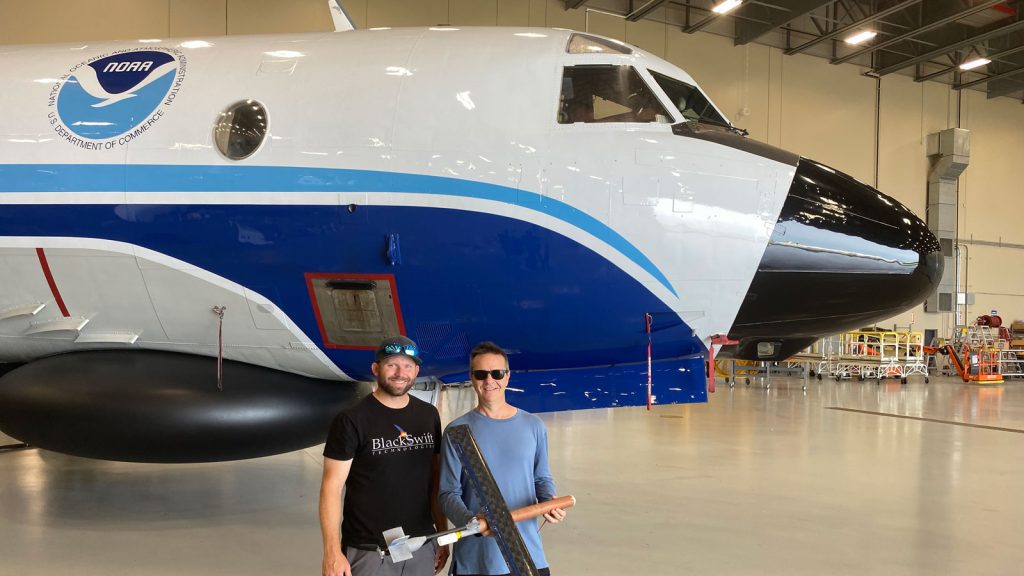
For the first time, data from a small uncrewed aircraft system (sUAS) – Black Swift Technologies’ S0 – will be integrated into NOAA’s hurricane forecast model during the 2026 hurricane season. Scientists from the Cooperative Institute for Marine and Atmospheric Studies (CIMAS) and NOAA’s Atlantic Oceanographic and Meteorological Laboratory (AOML) determined that incorporating sUAS data […]

NOAA Ocean Exploration and AOML collaborate to release first eDNA data from Okeanos Explorer
This story is adapted from NOAA Ocean Exploration. See the full story here. In April, NOAA Ocean Exploration, in partnership with NOAA’s National Systematics Laboratory at the Smithsonian National Museum of Natural History, the Northern Gulf Institute, and the Atlantic Oceanographic and Meteorological Laboratory, released its first deep-sea environmental DNA (eDNA) datasets. These biological data […]

Scientists at AOML monitor the impacts of ocean acidification on reefs with new series of buoys
Divers drop over the gunnel. Tanks, weights, divers, and a mesh bag full of tools all descend in emerald waters beneath grey skies. Off the vessel’s bow, a yellow beacon blinks with a red flashing light and a thin data cable stretching to the seafloor, all connected to a suite of sensors twenty feet below […]

Alongshore winds drive variability of key biogeochemical processes
There’s a unique interplay between surface winds, the Gulf Stream current, and the continental shelf in the South Atlantic Bight (SAB), that has long been overlooked. Researchers have often speculated that the strength of the Gulf Stream and proximity to the coast impacts primary production and other processes driving essential ecosystems. However, to what degree […]

From sample to source: tracking pollution pathways in AOML’s Molecular and Environmental Microbiology Lab
With sterile sample bottles at the ready, scientists in the Molecular and Environmental Microbiology Lab at NOAA’s Atlantic Oceanographic and Meteorological Laboratory (AOML) prepare to capture water samples for analysis in the lab. Invisible to the naked eye, nutrients, pollutants, and entire communities of bacteria, algae, and other microorganisms drift through these waters leaving clues […]

Scientists at AOML lead workshop for international Surface Ocean CO2 Reference Observing Network (SOCONET)
Last week, scientists with AOML’s Ocean Carbon Cycle team led a workshop under the international Surface Ocean CO2 Reference Observing Network (SOCONET) on best practices for maintaining an underway pCO2 system and quality-controlling data to standardize crucial measurements of the surface ocean’s uptake of carbon. The global ocean takes up carbon from the atmosphere on […]

New study suggests electrochemically-induced Alkalinity Enhancement can enhance coral growth rates
In a new study led by scientists at NOAA’s Atlantic Oceanographic and Meteorological Laboratory (AOML) and the Cooperative Institute for Marine and Atmospheric Studies (CIMAS), a novel form of alkalinity enhancement (AE) was demonstrated to significantly enhance the growth rates of corals, a finding that could promote the scaling of coral reef restoration. Coral reef […]

Antarctic Bottom Water contraction drives abyssal ocean warming along SAMBA-West line (34.5°S) in the Argentine basin
Santos, D. M. C., T. C. Bilo, et al.
We present an updated assessment of abyssal temperature trends in the Argentine Basin using expanded hydrographic and moored observations from the SAMBA-West line. The study addresses two main questions: (1) What is the spatial distribution of the abyssal warming along the SAMBA-West line? (2) What mechanisms drive the observed changes? Using output from a high-resolution numerical simulation, we first characterize how the abyssal flow near 34.5°S relates to the broader basin-scale circulation, providing context for interpreting the observations. Within this framework, we find that SAMBA-West is situated within a dynamically complex junction of deep boundary currents and recirculation pathways in the northwestern portion of the Argentine Basin. A coherent, statistically significant warming trend is found across most of the array and vertically throughout the AABW layer, primarily due to its vertical contraction, likely reflecting reduced formation or export of the AABW.

Subsurface biogeochemical response to Hurricane Idalia within a cyclonic eddy and river plume–stratified environment
Jennifer K. McWhorter, Lev B. Looney, et al.
Satellite observations can reveal chlorophyll blooms in the wake of hurricane disturbances but their subsurface biogeochemical anomalies remain poorly described due to limited in situ observations. Here, we quantify the biogeochemical response across the ocean water column to Hurricane Idalia (2023) in the Gulf of America (also known as the Gulf of America). We compile observations across the eastern Gulf using satellite data and two autonomous platforms: a profiling Biogeochemical-Argo (BGC-Argo) float and saildrone. Prior to the formation of Hurricane Idalia, an anomalously large extension of the Mississippi River plume spanned much of the eastern Gulf, contributing low-salinity and high-chlorophyll conditions. Following Idalia’s passage, the saildrone observed surface chlorophyll increases in the river plume extension, while the BGC-Argo float observed subsurface nitrate depletion and oxygen enrichment. These changes occurred as the float measured background ocean conditions evolving from the edge of the Loop Current to a cyclonic eddy, influenced by the river plume extension. Increases in chlorophyll concentration, decreases in nitrate, and elevated dissolved oxygen levels suggested increased primary production. BGC-Argo float observations revealed enhanced upwelling below the surface layer (~22 m) that shoaled the nitracline, fueling the increase in subsurface primary production (20–50 m depth). Our study provides a glimpse on the surface and subsurface ocean-biogeochemical changes associated with the Hurricane Idalia passage, highlighting the importance of the background mesoscale seascape on shaping the phytoplankton response to hurricane-induced disturbances. The combination of observations underscores the value of continuous in situ monitoring to better understand hurricane-driven impacts on the full ocean water column and the impacts these dynamics have on the base of the marine food web.