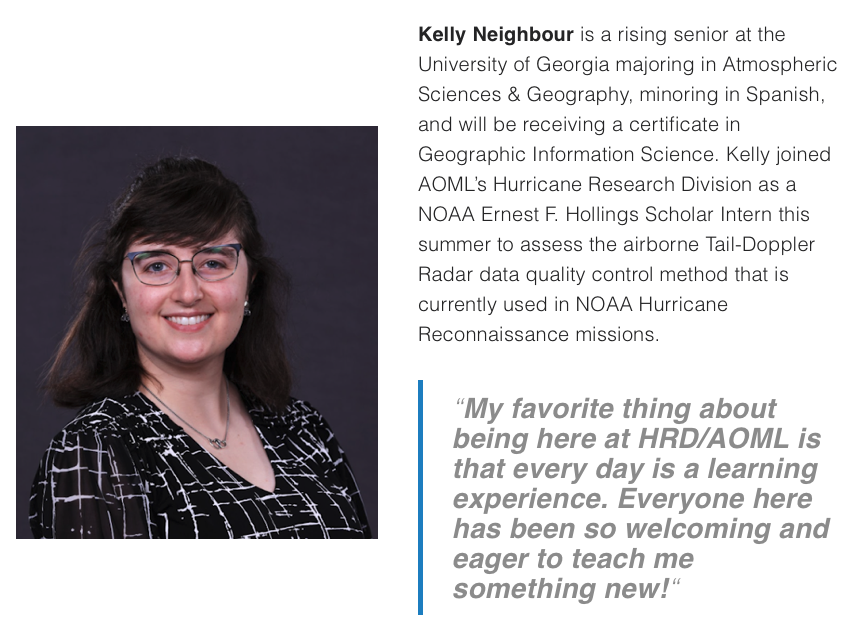
On National Intern Day, AOML is celebrating our 2023 summer internship class ranging from high school students to post doctoral fellows. They are joining us from schools across the country, from Hawai’i to Florida, and are researching corals, microbes, hurricanes, air-sea interaction, ocean acidification, communications strategies, and much more. Some of the 2023 interns are Ernest […]
Read Full Article
Research Highlights February 27, 2026New study shows the aftermath of a deadly coral disease on the coral reef microbiome December 22, 2025Employing ‘Omics techniques to examine crucial restoration efforts across the Mission: Iconic ReefsMarch 26, 2025New study demonstrates the impacts of multiple stressors on reef-building corals Research Interests Data Analytics, microbiology, gene expression, immunology, coral disease [...]
Read Full Article
Maribeth L. Gidley, Ph.D. Assistant Scientist, Ocean Chemistry and Ecosystems Division 305.361.4445 Maribeth.Gidley@noaa.gov 4301 Rickenbacker Causeway Miami, Florida 33149
Read Full Article
Tyler Christian Research Associate, Ocean Chemistry and Ecosystems Division 305.306.2869 Tyler.Christian@noaa.gov 4301 Rickenbacker Causeway Miami, Florida 33149 AboutCurrent Work & CVEducationAbout Tyler Christian joined the staff of AOML’s Ocean Chemistry and Ecosystems Division as a University of Miami-Cooperative Institute Research Associate. Tyler works as a laboratory technician for the Nutrients Lab with duties that include [...]
Read Full Article
Research Highlights March 28, 2025NOAA cruises set the foundation for restoring crucial Florida ecosystemsOctober 19, 2020NOAA’s New National Marine Ecosystem Status Web ToolMay 19, 2020Florida Keys Integrated Assessment Team Launches New Ecosystem Status Report Web Tool Research Interests I am interested in the relationship of coastal ecology, ecosystem services and providing the best science to [...]
Read Full Article
Jhon F. Mojica, Ph.D. Senior Research Associate, Ocean Chemistry and Ecosystems Division 305.361.4425 Jhon.Mojica@noaa.gov 4301 Rickenbacker Causeway Miami, Florida 33149 AboutCurrent Work & CVEducationPublicationsAbout Dr. Jhon Mojica joined AOML’s Ocean Chemistry and Ecosystems Division as a University of Miami-Cooperative Institute Senior Research Associate. Jhon supports the Port Everglades Adaptive Management Moorings and Expert Information System [...]
Read Full Article
Research Highlights July 2, 2017Live! Science at Sea: Gulf of America Ocean Acidification Cruise Research Interests I am passionate about understanding the dynamics of climate change and the implications for the ocean/coastal ecosystems. Patrick Mears Research Associate, Ocean Chemistry and Ecosystems Division 305.361.4519 Patrick.Mears@noaa.gov Patrick_Mears 4301 Rickenbacker Causeway Miami, Florida 33149 AboutCurrent Work & CVEducationPublicationsAwardsAbout [...]
Read Full Article
NOAA’s National Hurricane Center — a division of the National Weather Service — has a new model to help produce hurricane forecasts this season. The Hurricane Analysis and Forecast System (HAFS) was put into operations on June 27 and will run alongside existing models for the 2023 season before replacing them as NOAA’s premier hurricane forecasting model. HAFS was jointly created […]
Read Full Article
Rachel Cohn Research Associate, Ocean Chemistry and Ecosystems Division 305.814.2749 Rachel.Cohn@noaa.gov Rachel_Cohn 4301 Rickenbacker Causeway Miami, Florida 33149 AboutCurrent Work & CVEducationAbout Rachel Cohn joined the staff of AOML’s Ocean Chemistry and Ecosystems Division as a University of Miami-Cooperative Institute Research Associate. She is currently conducting field work in support of NOAA’s Integrated Ecosystem Assessments [...]
Read Full Article
Research Highlights June 25, 2025Ocean Month: Exploring and understanding our ocean through research cruisesMay 28, 2025Australia to Thailand: I09N GO-SHIP cruise completes voyage May 2, 2024Floating ice, freezing temperatures: Four facts about the I08S GO-SHIP cruise to Antarctica Katelyn Schockman Ph.D. Assistant Scientist, Ocean Chemistry and Ecosystems Division 786.268.9329 Katelyn.Schockman@noaa.gov Katelyn_Schockman 4301 Rickenbacker Causeway Miami, Florida [...]
Read Full Article