The document aligns with AOML’s three goals: Goal 1: Empower Our Team. Create an inclusive and cutting-edge environment that fosters discovery, exploration, and success. Goal 2: Observe the Earth System: Collect and evaluate ocean, atmosphere, and marine ecosystem observations that contribute to the body of scientific knowledge of the Atlantic Ocean region to improve the ability to […]
Read Full Article
Recap of the 2021 hurricane season, recent research results on wind shear direction and intensity change, Saildrones, and other news on HRD employees. Check it out here. For more information, contact aoml.communications@noaa.gov.
Read Full Article
Research Interests Numerical weather prediction. Data assimilation. Observing system experiments (OSEs). Observing system simulation experiments (OSSEs). Uncrewed aircraft systems (UAS). Reconnaissance aircraft observations. Brittany Dahl Senior Research Associate I (University of Miami/CIMAS), Hurricane Research Division 305.631.4402 Brittany.Dahl@noaa.gov 4301 Rickenbacker Causeway Miami, Florida 33149 "I am a scientist because I enjoy learning about the world around [...]
Read Full Article
February’s science meeting, co-hosted by the National Hurricane Center (NHC), provided an update on developments of the Hurricane and Ocean Testbed (HOT), a new facility at NHC dedicated to facilitating the transition of research and development projects to operations in a physical space. For many years, NHC partnered with NOAA’s Office of Oceanic and Atmospheric Research via […]
Read Full Article
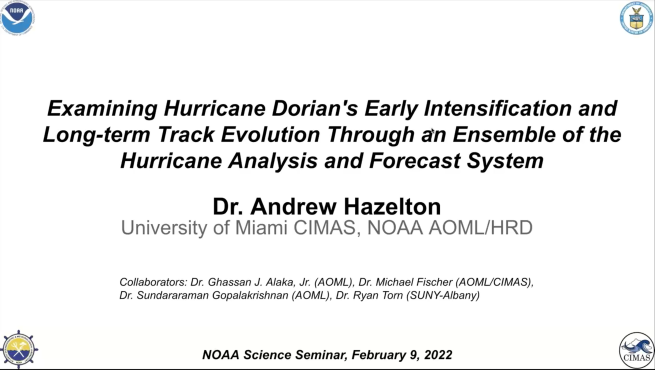
Dr. Hazelton presented a seminar titled “Examining Hurricane Dorian’s Early Intensification and Long-term Track Evolution Through an Ensemble of the Hurricane Analysis and Forecast System”. ABSTRACT: Hurricane Dorian (2019) was one of the strongest hurricanes on record in the Atlantic basin, and caused significant devastation across the northern Bahamas as it stalled out as a […]
Read Full Article
Research Highlights May 3, 2022Hurricane Model that Follows Multiple Storms Improves Intensity ForecastsFebruary 3, 2021AOML Hurricane Scientists Facilitate Leap in Hurricane Modeling and Prediction SystemsJuly 1, 2020NOAA Hurricane Model Performance is Evaluated for the First Time in Predicting Rainfall from 2017 Hurricane Harvey Research Interests Numerical weather prediction. Model developments. Boundary layer meteorology. Numerical modeling [...]
Read Full Article
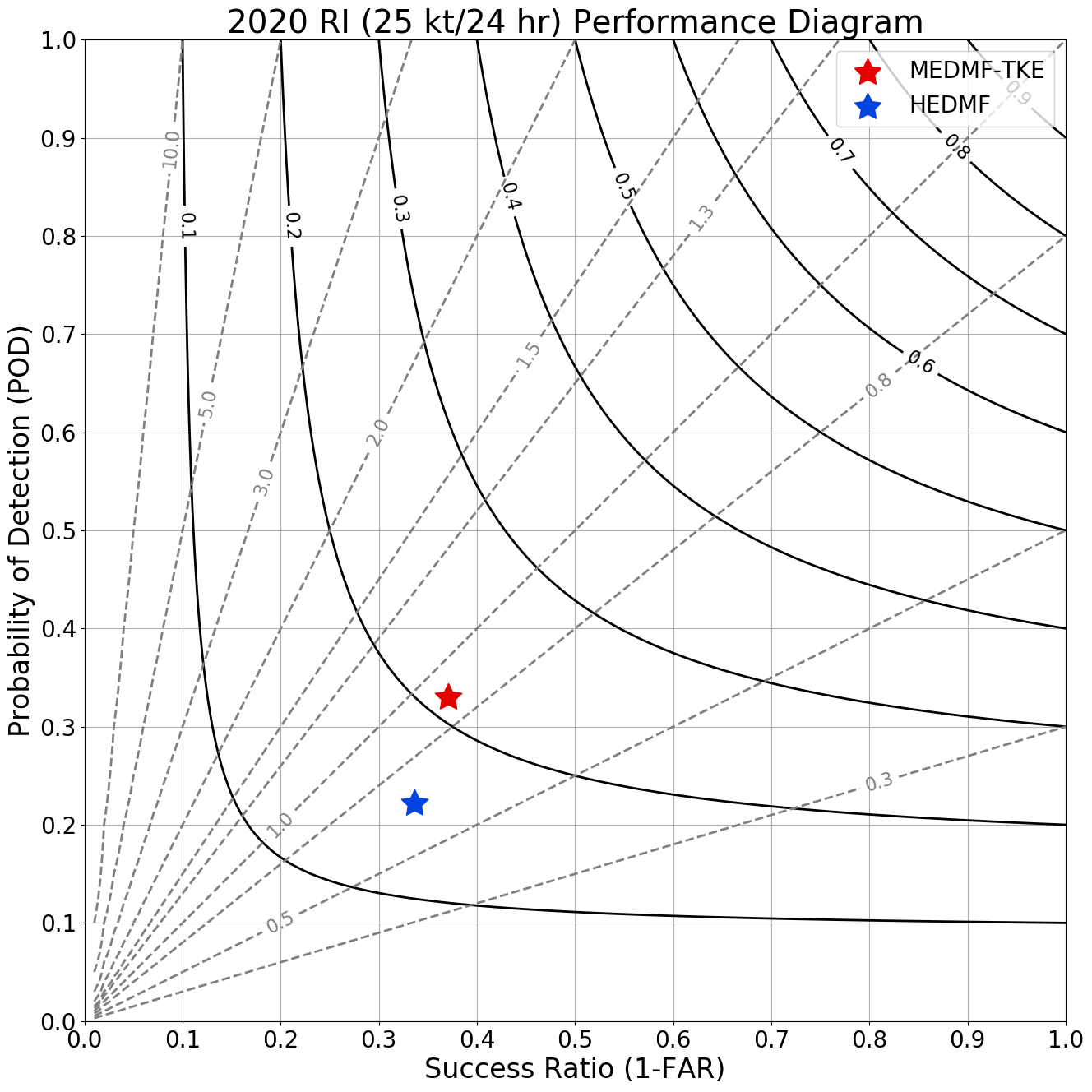
We modified the way NOAA’s new hurricane model forecasts what happens in the lowest part of the atmosphere based on observations from Hurricane Hunter research flights. The new scheme produced track forecasts that were up to 20% better than from the older scheme, a 15% improvement in detection of rapid intensification events, and smaller tropical […]
Read Full Article
NOAA’s Atlantic Oceanographic and Meteorological Laboratory is pleased to announce Jasmin John as AOML’s Ocean Chemistry and Ecosystems Division new deputy director.
Read Full Article
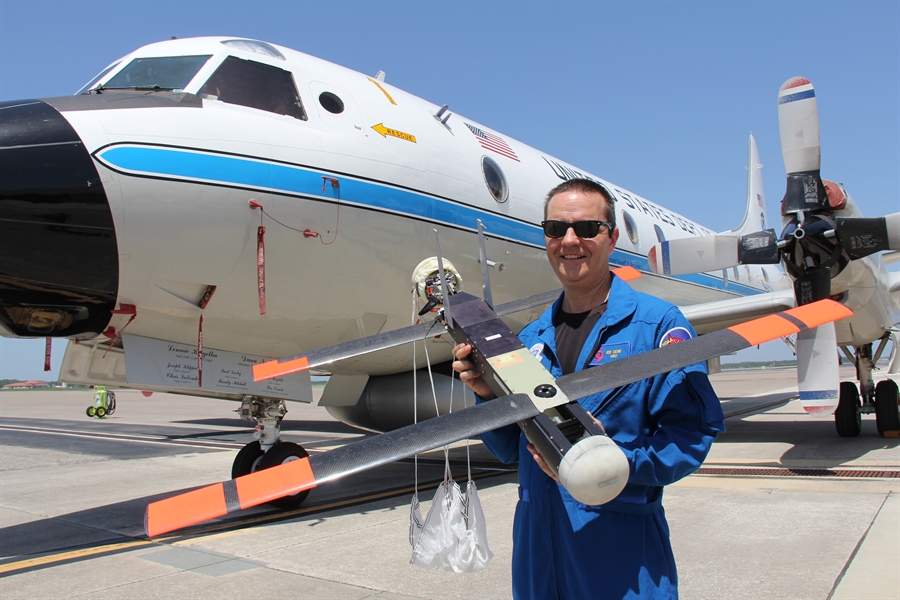
For the first time, near-surface observations obtained by small Uncrewed Aircraft Systems (or drones) in a major hurricane (Hurricane Maria of 2017) were utilized in a state-of-the-art computer. Such observations are impossible to obtain using regular hurricane hunter aircraft. Furthermore, a new technique to identify and eliminate observations that may not be useful in improving analyses or […]
Read Full Article
After several years of dreams, plans and construction, NOAA’s National Hurricane Center (NHC) has launched a new era of applying the latest “research to operations” at the recently opened William J. Lapenta Laboratory. The research will take place in a new lab named in memory of the late Dr. William “Bill” Lapenta. As director of […]
Read Full Article